
A conversation on Latinx environmentalisms with Carlos Alonso Nugent and David J. Vázquez
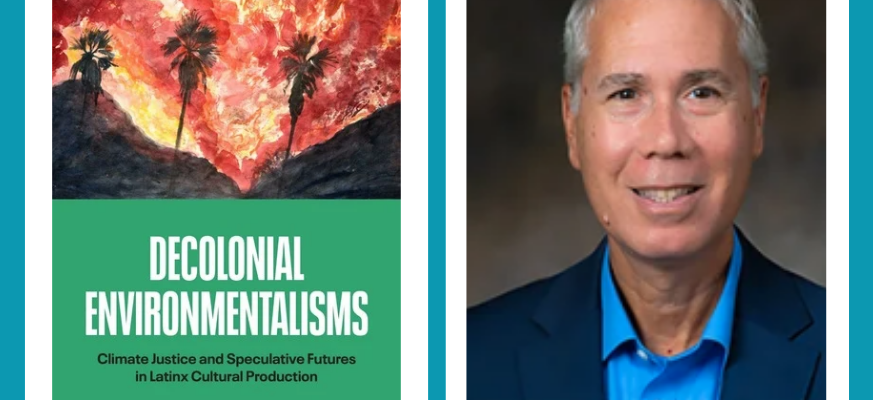
Decolonial Environmentalisms: Climate Justice and Speculative Futures in Latinx Cultural Production by David J. Vázquez (University of Texas Press, 2025)
For much of the twentieth century, the people who were coming to be called “Latinx” were excluded from the practices that were coming to be called “environmentalism.” But in the 1970s, 1980s, and 1990s, everyone from Chicanxs in Los Angeles to Boricuas in Nueva York began calling attention to their strategies for connecting with more-than-human entities. Since the start of the twenty-first century, these strategies have received recognition in history, geography, anthropology, sociology, and above all literary and cultural studies: thus, while 2016 saw the publication of both Priscilla Solis Ybarra’s Writing the Goodlife: Mexican American Literature and the Environment and Sarah D. Wald’s The Nature of California: Race, Citizenship, and Farming since the Dust Bowl, 2019 brought the essay collection they co-edited with David J. Vázquez and Sarah Jaquette Ray, Latinx Environmentalisms: Place, Justice, and the Decolonial. Over the summer, this growing bookshelf received its latest item in Vázquez’s much anticipated Decolonial Environmentalisms: Climate Justice and Speculative Futures in Latinx Cultural Production (2025), so this fall, Vázquez joined Carlos Alonso Nugent in an email correspondence about the book.
Carlos Alonso Nugent (CAN): It’s great to be back in conversation! Like many in Latinx studies and the environmental humanities, I could not wait to get my hands on this book, but for those who are only learning about it now, why don’t you begin by sharing a few of its most important insights?
David J. Vázquez (DJV): Thanks, Carlos, for engaging with my work. Decolonial Environmentalisms in many ways owes its genesis to a conversation that emerged between the co-editors of Latinx Environmentalisms about the intersections of the environmental humanities and Latinx Studies. One of the things that quickly emerged from that conversation was that settler colonialism is an issue that is not adequately addressed in either EH or Latinx Studies. Although we opened this conversation in Latinx Environmentalisms, I think we have been fairly criticized for not sufficiently centering decolonial ideas. Every project has its limits, so I decided that Decolonial Environmentalisms would take up this conversation in a more fulsome way. I think one of the chief insights of Decolonial Environmentalisms is that Latinx literature and culture often (although not always) infuse their environmental critiques with critiques of racial capitalism, including its manifestations in settler colonialism. While these decolonial moves are tenuous and incomplete, the book focuses on how decoloniality is a sustained interest among Latinx creators across multiple media forms.
I also sought to think through how authors and artists across Latinx communities (Dominicans, Puerto Ricans, Chicanxs, etc.) are making similar (although not identical) decolonial moves. Comparative work reveals some of these commonalities. The book is thus attempting to broaden both the archive of Latinx environmental texts and the environmental issues authors and artists consider.
CAN: This response clarifies one of the things that makes the book so compelling: while acknowledging that Latinxs have taken shape through Spanish, British, Mexican, US, and other colonialisms, the book still finds ways to think decolonially. Your simultaneous attention to colonialism and cultivation of decoloniality is evident in your opening epigraph from Gloria Anzaldúa: “I am an act of kneading, of uniting and joining that has not only produced both a creature of darkness and a creature of light, but also a creature that questions the definitions of light and dark and gives them new meanings” (1). What else do these words mean to you, and why else did they seem like the best way of beginning your book?
DJV: First, I love Anzaldúa. She was, as you know, a very early advocate for decolonial environmental thinking. The book felt incomplete without engaging her in some way. Books are haunted (to use Avery Gordon’s rich term) by certain authors or ideas that may not be objects of analysis, but are there nonetheless. Decolonial Environmentalisms is haunted by Anzaldúa. Her anti-dualistic thinking has been a touchstone for how Latinxs reject conventional forms of environmentalism rooted in the Cartesian split (to gloss Priscilla Solis Ybarra’s brilliant Writing the Goodlife).
But more than this, I was haunted by the idea of weaving, of intertwining strands of environmental thinking. I think Anzaldúa models such complex frameworks. From the outset, I knew that what really bothered me about EH readings of Latinx environmental texts was that they almost never break out of the framework of environmental justice–which is a fine framework, but leaves so much interesting thinking on the table. For me, Anzaldúa’s words were a way to set a mood that was more about exploring possibilities that are often decolonial, even if they’re not pure and progressive. Anzaldúa’s thinking gives us a way to grapple with the complexity of ideas, rejecting static orientations. She fundamentally rejects the possibility of staying locked in rigid binary thinking–or even of remaining locked into a static positionality. She instead insists on a mobile and evolving framework of opposition to racial capitalism. For me, this was always a key way to think about moving through the arguments: to refuse to shy away from the infelicities, even as I valorize how these creators push against racial capitalism.
For example, I explore in the book how an author like Valeria Luiselli critiques the idea of the Western US as a land of freedom and expansive possibilities. She reclaims the history of Mexican and Indigenous presences in the West, but she also connects these ideas to critiques of preservationist discourses that exclude humans from the landscape. The trouble with Luiselli is that she operates from a very privileged, elite perspective. Her book is not only formally experimental (something that literary critics like me enjoy, but that might not appeal to every reader), but also quite rooted in Eurocentric elitism. Does this mean that she doesn’t have something valuable to say about Western history, extractivism, or vicious immigration policies? No, of course not. Anzaldúa provides us with ways of thinking that allow us to understand complex ideas, texts, and works of art in complex ways.
CAN: “Rejecting static orientations” is an apt account not only of Anzaldúa’s creativity, but also of your interest in genre: with a first chapter on migrant farmworker activism in California, a second chapter on spatial struggles in Nueva York, a third chapter on a pair of anti-westerns, and a fourth chapter on science fiction, your book looks at how Latinxs take up and transform conventions. Yet as I wrestled with these four genres, I could not help noticing how they emerged in an equally expansive array of media, from texts to art objects to films. How would Decolonial Environmentalisms differ if it were organized around media rather than around genre? Are there aspects of its arguments that are especially suited to writing, or to printmaking, or to filmmaking? Since Latinxs are so multilingual, are there distinct possibilities and/or problems for Anglophone and/or Hispanophone media, as opposed to for non-linguistic media?
DJV: I’ll take the last question first. This book would have looked quite different if I were to consider multilingual work. Renee Hudson’s Latinx Revolutionary Horizons: Form and Futurity in the Americas (2024) and Maia Gil’Adí’s Doom Patterns: Latinx Speculations and the Aesthetics of Violence (2025) both do a much better job of exploring the boundaries of latinidad from the standpoint of multilingualism, including in relation to Filiapinxs, Haitians, Brazilians, and others. Although I admire these books, my work is grounded in my training in US race and ethnic studies. So while I think it’s fair to think about how this work might apply to other linguistic frameworks in the US and beyond (which I’m sure have similarly interesting perspectives on decoloniality and environmentalism), there was already too much material to consider from Anglophone Chicanx, Puerto Rican, Dominican, etc. communities. I realize that this might be an unsatisfying answer, but no book can do everything. I think the multilingual work you rightfully point to could be an important jumping off point for other scholars.
It’s also true that the book could have been organized according to media, as you suggest. I think what I found compelling about genre was a conversation that Ralph Rodriguez opens in Latinx Literature Unbound: Undoing Ethnic Expectation (2018). There, Rodriguez advocates focusing on genre and “what texts do,” rather than the identity of the author. Although I am not a neo-formalist, I found the invitation to consider texts from the standpoint of genre to be compelling. It also felt like this genre framework opened up the comparative aspects of the book. Reading, for example, Alex Rivera’s film Sleep Dealer (2009) alongside Sabrina Vourvoulias’s novel Ink (2018) turned out to be a really interesting way to get to issues around land use, Indigeneity, etc.
But you ask how the book might be different if I organized around media, comparing, say, Ester Hernández’s posters with those of DYPG. I think it would have certainly entailed different forms of analysis, but I’m not sure if the conclusions would have been radically different. What I find interesting about comparative work is identifying similarities and differences within an archive. This question has me curious about other configurations. In the end, we can only do what we do, but it’s fun to speculate about other possibilities for the work.
CAN: The way you trace both genres and media through different diasporas makes me think back to your first book, Triangulations: Narrative Strategies for Navigating Latino Identity (2011), and while our conversation to this point has focused on how Latinxs have transformed environmentalisms, it strikes me that your book also shows how thinking environmentally opens new understandings of identity. How has Decolonial Environmentalisms changed your sense of Latinidad, whether in the “Latin-” or in “-x”?
DJV: Ha! You ask the $60,000 question! As far as the “-x.” the “-e,” or any of the other gender expansive notions of Latinidad, I’m on board with what the late scholar Ricardo Ortiz notes about Latinidad more broadly: it is more of a becoming, a process, than a static identity. From this standpoint, it makes sense to me that we might be able to observe evolving concepts of identity that are rooted in resistance to racial capitalism.
The more interesting part of this question is how thinking environmentally can reconfigure how we think of identity. I have to confess that this was not a part of my thinking as I was drafting, but your question opens rich possibilities. The first is something that I pick up on in Ybarra’s work. She argues that the framework of environmentalism as an activist identity isn’t the full story for Latinxs – and I agree with her. I think that many of our cultures value living well with and in relation to the Earth in ways that are in excess of racial capitalism. Of course, I’m not claiming that all Latinxs are environmentalists, nor that all of Latin America shares environmental values. Any cursory analysis of our behavior (I’m reminded of Laura Pulido’s excellent question in her Preface to Latinx Environmentalisms: “What about lowriders?”) contradicts this type of essentialism.
Nonetheless, if we’re looking for archives where we can find values that integrate humans into the natural world, living well with the Earth is a cultural value we can consistently observe in Chicanx, Puerto Rican, Dominican, and lots of other Latin American diaspora populations. I would argue it’s a central aspect of many of our cultures, from recreating in a public park, to cultivating flowers or herbs in an urban window box.
The other thing that I’d say is that, glossing Roderick Ferguson’s We Demand: The University and Student Protests (2017), no forms of power operate without resistance. To think that we exist solely as objects of environmental harm misses our innovative resistance strategies. This is part of the reason I wanted to break out of the justice/injustice binary. There’s a deeper critique of racial capitalism that circulates in our cultures that is central to many of our identities. It seems relatively obvious, then, that thinking environmentally opens up these possibilities. I could go on, but I hope that these preliminary thoughts are addressing this excellent question.
CAN: Like all the best answers, yours are raising yet more questions! While ours is one of the first published conversations about Decolonial Environmentalisms, I am sure it will not be the last, and moving forward, I am eager for all of the ways that others will build on this book!