
The Subversive Sticker Project (or SubStick) is an intellectual excursion, an experiment in public humanities, and a threshold test of what it means to be a public intellectual.[1] Through SubStick, I create vinyl decals (i.e. stickers) as a means for exploring how arts and humanities efforts can foster reflection about the world we live in. Each SubStick consists of three elements: an image, text, and a QR code linking to an online resource. In essence, SubStick is a public and digital humanities project with a DIY bent. I design, print, laminate, and cut the stickers myself. I then disseminate the stickers in local gathering places such as coffee shops. What makes a sticker subversive? The subversive nature of SubStick emerges by recognizing that the most radical things we can often do are read, learn, ponder, reflect, forge relationships, and make things ourselves.[2] The text and image work together to draw in viewers. Together the graphic depiction and the carefully chosen words catch the eye, snare the mind, spur the imagination. The QR code, then, serves as a portal that takes someone to online resources to further their learning so that they may ponder and reflect. This sticker-making project can be incorporated into classes to foster a set of pedagogical opportunities.
In spring 2025, I incorporated SubStick into the final project for my undergraduate course on Chicana/o/x literature, and my colleague Sujey Vega also allowed me to pilot the project in her Introduction to American Studies class. Configured into a formal assignment, sticker-making is a fun, engaging opportunity for students to explore further topics that they are passionate about, consider how they might spark inquiry within a broader public, and be creative while honing critical thinking skills. Incorporating sticker-making into the college classroom allowed me to explore both pedagogical implications and practical considerations. Because the heart of SubStick is not simply designing stickers but disseminating seeds to grow arts and humanities thought, students in these classes were able to, should they choose, have their stickers printed and disseminated at Arizona State University’s Hayden Library and in local gathering spaces.
Both classes that participated in the SubStick project were taught on ASU’s Tempe campus. ASU serves approximately 75,000 students on the Tempe campus alone (183,000 students total). Propelled by a charter that states that “ASU is … measured not by whom it excludes, but by whom it includes and how they succeed,” ASU strives to be inclusive and representative of its local community. Many (42%) undergraduates are first-generation college attendees and hold one or more jobs while earning their degrees. In 2022, ASU was designated a Hispanic Serving Institution. Both classes drew students from across the university, majoring in fields like English and business, psychology and animation. Because I spent significant time with the Chicana/o/x literature students, most of my observations come from that class.
A SubStick Assignment and Considerations
As a final project for my Chicana/o/x literature class, students were required to design their own subversive stickers focused on a reading, historical figure, issue, or theme, we had discussed. The sticker, however, was only 50% of the project grade. For the other 50% students also had to write an 800-word essay explaining their design choices, rhetorical strategies, and ethical considerations.[3] The SubStick project required students to think through how to spark inquiry within their audiences and which online sources would best serve as a gateway into reflection. This fun project packs a lot of thinking into a memorable experience and short writing. You can find an assignment description here.
Some practical considerations made this project successful as a culminating experience. Because I wanted students to identify potential ideas for their SubSticks during the semester, I previewed this assignment early on and occasionally mentioned it throughout the semester. I also posted and briefly spoke about the assignment description at the mid-point of the semester to connect student attention from our discussions to the SubStick project. Toward the end of the semester, I reserved two class sessions for SubStick workshops. Initially I thought I would need to help some of my students learn Canva or other apps. However, only one student had never used Canva before, and within 15 minutes, she was doing just fine. Most students chose to use Canva, but others also used ProCreate, Photoshop, Google Slides, and other applications. I also allowed students to use AI for digital alteration of images on this assignment.[4] Because the class is not part of an arts or design program, it is important for students to have an array of means to produce work that they can be proud of. Nonetheless, in quite different ways, each of their stickers–whether created with software or hand-drawn—displays the DIY orientation of SubStick.
The workshop sessions functioned as independent working opportunities where students received feedback from their peers and from me. Peers would often give guidance on aesthetic or technological concerns. I would roam around the room and address issues pertaining to the rhetoric, design, and ethics. In terms of rhetoric, I often prodded students to consider their specific audience and asked how the text and image might lure them in. I also inquired as to what they wanted their audience to consider and how the online source might deliver that. For design, I kept my comments supportive: “Great job! Keep going!” was my most common refrain. I also framed advice as a question (e.g. “Is that the optimal location and size for the QR code?” or “Have you printed a proof sheet and tested the QR code?”). Regarding ethics, I asked students to reflect upon their sources’ reliability and why that matters in an age of rampant misinformation. They were also asked to think about issues of accessibility (e.g. “Is there a paywall?”).
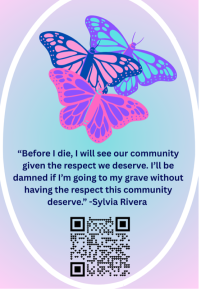
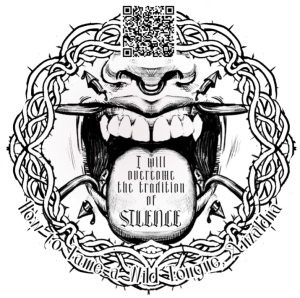
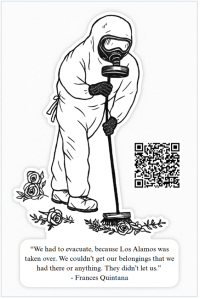
At the end of the semester, 19 Chicana/o/x literature students submitted individually designed SubSticks, and Dr. Vega’s class turned in seven SubSticks because they completed the project as groups.[5] The SubSticks evidence an impressive range of abilities, interests, and choices, as shown in the examples below. Raf Rios’ (Figure 2) and Peyton Bryan’s (Figure 3) SubSticks began as hand-drawn illustrations. The aesthetic skill and care that they demonstrated is far outside my ability as a sticker-maker. Their skill allowed them to keep the stickers monochromatic and remain visually appealing. The QR codes both direct users to traditional sources of information (i.e. a reading for Rios and a museum for Bryan). The stickers by Parker Lopez and Blake Lucas illustrate another approach, using vibrant color schemes and found images to gain viewers’ attention. Their QR codes both link to local nonprofit organizations that connect to the SubSticks’ themes.
Lessons Learned, or What Stuck with Me
When I first began exploring the idea of SubStick, I approached it with trepidation. A fun and odd experiment, SubStick allowed me to relax, play, and explore the limits of public intellectual work. For years I had seen people with stickers promoting InfoWars and sources spreading disinformation and conspiracy theories. I worried about the cultural, intellectual, and political work those seemingly innocuous stickers might contribute to. SubStick offers a corrective where valid yet often undervalued information is recirculated in times of great exigency.
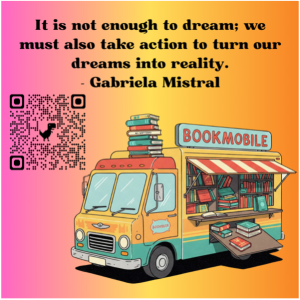
Trusted friends were enthusiastic about the project and asked if I would use this in my classes. I approached my students with the idea, and they loved this as a culminating project for the class. After moving past my initial anxiety and deciding to develop a SubStick pedagogy, I learned important lessons for others to know should they decide to incorporate a version of the Subversive Sticker Project into their classes.
Experience is more important than aesthetic skill or technological expertise. Before you add this assignment to your syllabus, you should spend 1-2 hours on Canva designing a sticker, buy a small package of supplies, and make your own prototypes with functioning, permanent QR codes.[6] If you run into issues, you can get help before the semester begins. Once the class starts, you can guide the students in the sticker-making process, but you do not have to worry about the aesthetic or technological expertise. Take the SubStick designed by Raf Rios (Figure 2), for example. Raf’s sticker was influenced by the opening passage of Anzaldúa’s “How to Tame a Wild Tongue” and depicts a mouth held open with hooks. It’s an amazing sticker that I could never design, but I also offered Raf input on size and scaling for the QR code so that it could function.
Structure and clarity. Because this is a multimodal project and each component has specific elements the student must include, I recommend providing students with a checklist of components and steps as well as a rubric for their SubStick and essay that you can then use for the evaluation of the project.
Drafts can elucidate process. I only required students to turn in their final SubStick and essay. However, one student, Peyton Bryan, drew by hand an image of a worker cleaning the contaminated area of Los Alamos, NM. Peyton then took a digital app and converted his drawing to develop the above (Figure 3). I often talk to students about my writing and revision process, which is quite extensive, and when I do so, I make analogies to processes in art. This SubStick project is an opportunity for educators to teach the process of revision if we make purposeful use of these drafts.
Cut in class if possible (bring band-aides). My American studies colleague brought in cutting supplies to class. I had printed out her students’ stickers and given her the supplies, so she used the time in class to let them laminate and cut their own SubSticks. I wish I had done this because it sounds like a great experience!
To group or not to group? Or loose collaboration? SubStick is an excellent opportunity to foster collaboration, but there are advantages and disadvantages to making this a formal group project. Because the project consists of multiple components that must cohere, forming groups with identifiable responsibilities makes sense. Moreover, as a group project, there are fewer stickers, and this makes printing prior to and cutting in class more feasible. Because of students’ time constraints, group projects may also require more designated class time. While my students worked individually, they also had the opportunity for loose collaboration. The workshops provided space for students to share ideas and questions, and they were not limited with whom they could work. Finally, you must consider the afterlife of your students’ projects. If they are only submitting them for grades, a group project will work. However, if you want to work with them to print, cut, display, and distribute their work, you will likely need to get informed consent forms signed by the students after the grades are assigned so that there is no danger of coercion. In that case, having groups makes it a logistical challenge in terms of getting the forms returned.
The Afterlives of Our Students’ Work
The SubStick assignment was an excellent way to end a semester by helping students think about their work beyond the classroom. Prior to their project, their writing assignments had been purposefully framed with real-world applications and audiences in mind. When I broached the subject of potentially displaying their stickers in the library and maybe even writing about them, the students were intrigued.
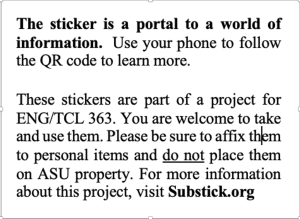
During the semester, I worked behind the scenes with the library to get permission to display the students’ work and with ASU’s IRB office for formal approvals, so that my students could make the choice to put their work on display. First, I contacted a friend at the library, told him about the project, and asked if we could display the stickers near the library’s zine collection. He put me in contact with Rachel Leket-Mor, the zine collection curator, who was very supportive. Unsurprisingly, the library folks were concerned about where the stickers might end up. So was I. We decided I could print an explanation label on the back of the stickers (Figure 6). After that we just needed to confirm with the library administrators that I had IRB approval.
The IRB process was fairly straightforward and required answering a few clarifying questions. The study was declared exempt, but the IRB office required that I use the consent form. Almost half of my students filled out the consent form. The week after finals, I printed, laminated, and cut the stickers. For the students who asked, I mailed them some of their own stickers to their home address with a quick note telling them to “have a great summer!” Beyond the library, I distributed SubSticks at coffeeshops and other suitable locations. Weeks after cutting hundreds of student stickers by hand, I asked my wife and intellectual partner if it was ethically permissible to buy a sticker cutting machine. I yearn to be the Johnny Appleseed of stickers and ideas. The Subversive Sticker Project is still in its nascent stages. You can find more examples and information and follow its progress at SubStick.org.
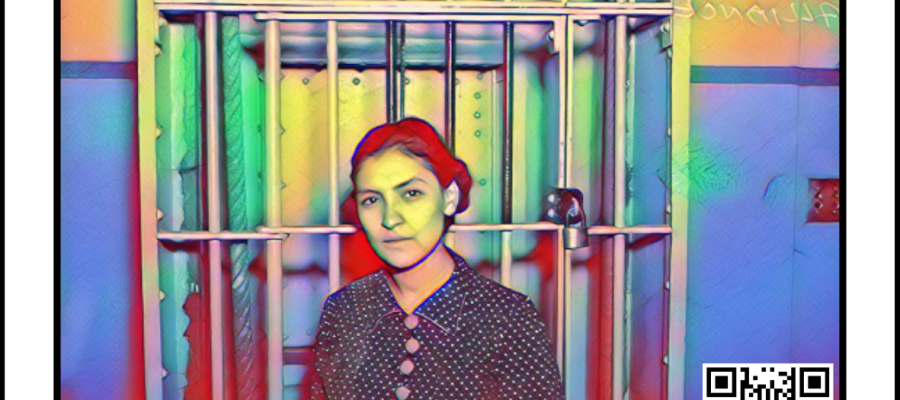
Featured Image/Figure #1: SubStick designed by Lee Bebout. CC BY-NC-ND. I have long been captivated by the black and white photo of Emma Tenayuca outside the jail cell: She appears so young and powerful here. I used a filter to add color to capture the vibrancy of her activism and commitment. The QR code takes viewers to a New York Historical Society Museum and Library source about her life.
Endnotes
[1] A note on terminology: I use “SubStick” to refer to both the project and the stickers.
[2] With my use of “subversive,” I am drawing on One-Dimensional Man, wherein Herbert Marcuse contends that in advanced industrial societies capitalism and communism both produce repression that limit critical thought and revolution. For me, the subjects of these SubSticks merely ask people to think and that is itself subversive because the subjects of these stickers have often been elided from broader public conversations.
[3] The intent here is to develop a sense of metacognition around the students “habits of mind.” Here I am drawing on the work of Kathy Yancey in Reflection in the Writing Classroom. Logan: Utah State University Press, 1998.
[4] I am ethically conflicted about this decision, but I want to be transparent about my practices.
[5] Only 2 of the projects were non-functioning because of trouble with the QR codes.
[6] Permanent or static QR codes are useful in creating links to information that does not change. In contrast, dynamic or temporary QR codes link to information that changes or expires.
This is amazing!