
Introduction
By Dr. Mark D Naison
These Reflections on Bad Bunny’s Super Bowl Halftime Show were written for a course at Fordham University (Bronx, NY) on the history of popular music called “From Rock and Roll to Hip Hop.” This course, which explores how the most important musical forms produced in the United States were profoundly shaped by Black culture, was selected as one of the most popular college courses in New York City by the New York Post in 2018. Since race and immigration are key themes in the course, Bad Bunny is one of the artists we highlight during the semester, so I gave students an opportunity to share their reflections on his Super Bowl performance to stimulate class discussion. These comments were so thought provoking that I decided to share them with interested scholars and teachers online, and we are very proud to learn they are now published in Latinx Talk!
A display of power in numbers
By Anna Gayton
Bad Bunny’s Super Bowl LX performance made a political statement based on the power of love and community. The performance has been highly anticipated since the initial announcement, and the momentum only picked up after his speech at Grammy’s following his win of Album of the Year. He said, “I want to dedicate this award to all the people who had to leave their homeland to follow their dreams” and “To all the Latinos in the world and all the artists who came before and deserved to be on this stage getting this award, thank you.” He also won Best global music performance and Best música urbana album.
The first thing that immediately stuck out to me is the amount of backup dancers. While isn’t atypical for Super Bowl performances, it immediately struck out to me as a display of power in numbers. I was glad to see so much joy in every performer’s face. Especially during a performance of cultural pride and resistance.
The large display of the farmland shows how Latinos have been the backbone to agriculture in the United States. Specialty Puerto Rico’s sugar cane and fruit farms. Some smaller nods such as the young boy falling asleep on the chairs referencing how many Latino kids fall asleep during parties. The football the boy had out said “Together we are America” and Bad Bunny also held this up. Additionally, I loved the wedding that took place as well, the symbol of unity, culture, and love. I’m sure there’s things I’m missing about the show too. But, I could tell everything was intentional.
One more thing I found really cute was he gave the young boy the gramophone paying homage to Bad Bunny’s own career and dreams. In my opinion the most special guest that stood out to me was Lady Gaga. Gaga is a proud queer woman and has allied herself with the lgbtq and trans community for years now. In the name of pop singers she has been a notorious critic of Trump throughout the years as well. He brought out a few other celebrities that perhaps I should know.
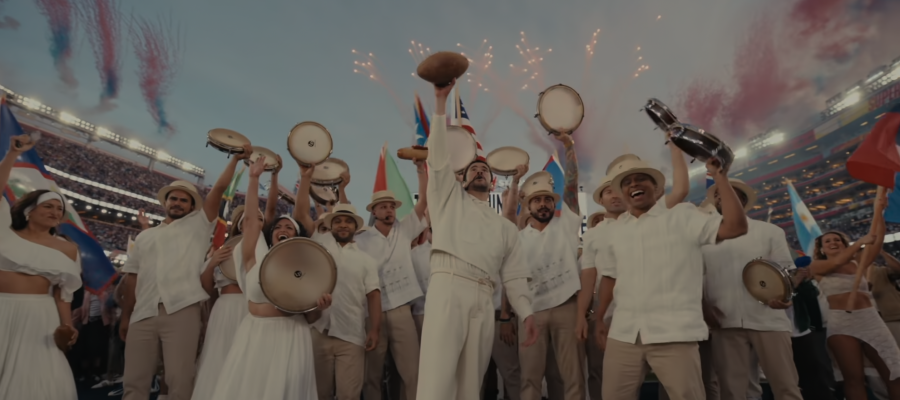
He also gave a shout out to every American country, north and south, during this performance of “DtMF” with a sea of beautiful flag., and the large billboard “The only thing more powerful than hate is love.” Read that again, the only thing more powerful than hate is love.
I found this performance to be 10x more interesting than the defensive game we all sat through. The Seahawks gave a more interesting performance during TNF this season. I’m happy for the Seahawks, but I’m even happier to see Bad Bunny perform as the first Latino American solo headliner.
Made me think a lot about language
By Seneca Farhy
This year’s Super Bowl halftime show really made me think a lot about language. It illuminated for me how music transcends language. I grew up in a bilingual household, however Spanish is not one of the two languages I grew up speaking. Despite not knowing what any of Bad Bunny’s songs were about, I was still moved so much by his performance. It made me think about how those who don’t speak English in the U.S. are forced to conform to the language norms of our country in order to communicate with those around them. It was astounding to me how enraged people could get over the fact that those that have to conform, for once, get to express themselves in their native language and culture without the pressure to fit the mold of what an American should look like, act like, or sound like. Watching Bad Bunny’s halftime show showed me that we do not always need language to communicate. Our differences, like language and culture, are not something that should keep us apart from each other; rather they should be shared, and even celebrated. In the case of music and dancing, it’s so much more fun to allow everyone to express themselves in the way they best know how to, and to learn a little bit more about how people do it differently. I really value the move that the NFL made with bringing Bad Bunny into a sphere that has so many different races and cultural identities. I think that he is a great reflection of the patchwork that makes up our nation and I think that his message of unity through love and compassion is one that we could all really use right now.
Your dreams are valid, and your heritage is your superpower
By Ashlanda Bannerman
The stage opens not with a quiet introduction, but with the roar of Monaco, a defiant celebration of success that sets the tone for a night of cultural reclamation. We see a wedding on stage, a sacred symbol of unity in the Latino community. Lady Gaga takes the stage and transforms the song “Die with a Smile” into a Salsa, dancing in sync that mirrors the blending of worlds. This dance is more than entertainment, but an assertion that marriage and love remain the center point of the Hispanic community, the “choose love” philosophy acting as a shield against the pressures of the modern world. The performance pays homage to the streets that birthed this movement. We see La Marqueta, the heart of New York City and the Brooklyn, filled with dancers who move with the spirit of the ancestors. In this space, icons like Cardi B and Karol G stand as pillars of modern success, while Ricky Martin remains the icon who paved the way.
The narrative shifts to a quiet, domestic scene: a young Hispanic child sits at home with his family, eyes glued to the screen as Bad Bunny wins a Grammy. An inspiring moment where Bad Bunny handed the trophy to the young boy. It is a silent promise: your dreams are valid, and your heritage is your superpower. However, the celebration is tempered by a harsh, grounding reality. As Bad Bunny holds the Puerto Rican flag, the imagery behind him turns somber. He highlights the “invisible” workers who risk their lives on a crumbling electrical grid, a system shattered by natural disasters and systemic neglect. The performance confronts the exploitation of Puerto Rico’s natural resources, specifically the sugar cane fields. Once a source of pride and wealth, these resources have a dark history of slavery and are now seen as being systematically siphoned by American colonizers. It is a reminder that the land is beautiful, but it is also a site of ongoing struggle.
For the children of immigrants, this struggle is deeply personal. The chilling reality of ICE and the pervasive fear that haunts immigrant households. This isn’t just a political talking point but a threat to our everyday lives. To be a daughter of immigrants is to carry the weight of my father’s journey, a man who worked in the United States as an “undocumented” and “illegal” immigrant by a country that was built on the backs of Black people and immigrants. As Billie Eilish said when accepting her Grammy for Record of the Year, “No one is illegal on stolen land”. The idea that a human being could be hunted simply for trying to work and build a dream is not just “sickening” but destroys the concept of the American Dream. Bad Bunny concludes with a radical act of inclusion. He names every Latin American and Caribbean country and every immigrant nation, bringing the “Dreamers” and the displaced into the spotlight. His football forms the words “Together We Are America,” reframing the national identity. He stands as a bridge between the exploitation of the past and the hope of the future. By ending on the Jumbotron that “the only thing more powerful than hate is love,” he challenges the audience to see the Hispanic community not as “others,” but as the very heartbeat of the nation. God bless America, the real America, which is paved with the sweat of immigrants and the vibrant colors of a thousand different flags.
The joy and culture of Latino communities
By Allyson Bartek
Bad Bunny’s halftime show was full of homages and symbols regarding his home of Puerto Rico. Some of the things I immediately noticed included: the workers in the sugar cane fields, the culture surrounding parties and get-togethers (the wedding), and the sapo concho.
First, a main part of the show, at the beginning and throughout the set, was the sugar cane fields and the people working in them. Throughout history, sugar cane plantations have been a central part of Puerto Rico’s history, whether that’s by the Spanish or the US. Puerto Ricans have been oppressed and forced into labor for the benefit of people who were not their own. This is contradictory to Bad Bunny actually playing at the Super Bowl; he, a Puerto Rican, has successfully become independent and almost powerful rather than under the power of someone else.
The next thing that stood out to me was the wedding scene. It was actually real, which I think is really representative of the community that Bad Bunny was working to portray throughout sections of his show. It gave insight into the way Puerto Ricans celebrate joy with one another, and while this was specifically a wedding, I think it can be reflective of other types of celebrations and the culture of celebration in general. We see people of all ages dancing with one another during this salsa section, which evokes happy feelings (at least for me). Seeing Bad Bunny dancing with a young girl definitely put a smile on my face. So many small details, such as the boy sleeping on the chairs, are reflective of the real-life experiences Puerto Ricans and other Latinos have during these types of events. It really works to show the joy and culture of Latino communities positively.
Lastly, the sapo concho was on one of the big screens around the football stadium. It’s an important animal to Puerto Ricans that is representative of their long history and the culture of Puerto Rico. The particular animated version of the toad is known as Concho and has been a major icon in Bad Bunny’s recent album, DtMF. The toad is an endangered animal in Puerto Rico, native to the island. Its imagery in the halftime show represents Puerto Rico’s own struggles with things such as displacement and development. Bad Bunny uses Concho as a way to subtly hint at this political message that advocated for better protection of PR’s culture and ecosystem, which is suffering due to things like climate change and habitat destruction.
All of these details found throughout Bad Bunny’s halftime show depict the pride and joy he has for Puerto Rico and its culture. It also brings attention to the issues they face.
One of the best parts of America
by Isabella Capito
Benito Antonio Martínez Ocasio, also known as, Bad Bunny won album of the year exactly a week before his Super Bowl halftime performance and in his acceptance speech he said, “The hate gets more powerful with more hate. The only thing that is more powerful than hate, is love” and that is exactly what his performance represented this past Sunday.
Currently, the U.S. has been racked with hate that is showing itself in discrimination, violence, prejudice, and many other ways. The hatred that immigrants have received over the past couple months (even years) is appalling. Not to mention, the profiling in order to paint these human beings as bad or dangerous. When it was first announced that Bad Bunny was headlining the super bowl, a lot of people were outraged. Specifically over the fact that his music is almost entirely Spanish. Not to mention, for some people he wasn’t “American” enough, even though he is a U.S. citizen. It got to the point where another organization coordinated another Super Bowl halftime show to be presented on another platform. All because of the stigma that surrounds Spanish speaking Americans and immigrants today. In all fairness, I would say that Bad Bunny had every right to fight hate with hate. The actions that have been taken by ICE recently have been atrocious. However, in the face of everything going on, he chose to express a message of love and togetherness during a time of hate and division. It speaks volumes of his character and the message he portrayed.
From the beginning of his performance we saw drink stands, people playing dominoes together, a nail artist, a taco stand, boxers, a jewelry stand, a family home, an entire wedding, many dancers (some of which were dressed in casual clothing), the flags of what seemed to be every country in North and South America, as well as the Puerto Rican flag, and lastly a football that stated, “Together, we are America.” Every single element here resembles togetherness. It made me think of the different people we encounter day to day all with a different background. It’s important not to take that for granted because it’s one of the best parts of America and what makes America, America. There is no America without the people who keep it going; and that includes immigrants. As well as togetherness, these elements also portrayed love. Especially the wedding they presented. It is extremely refreshing to see someone promoting love when so much of the world is consumed with hate right now.
Moved me to also fight in a similar way
By Imogen Buck
I thought that this year’s Super Bowl LX halftime show, featuring Bad Bunny, was the best one that I have ever seen and it really symbolized America for me in a way that I have never seen before. I have never listened to Bad Bunny, but following the performance, he has gained a fan. I don’t know if I have ever seen someone encapsulate America whilst also fighting the current position our country is in so well in such a short span, and the way that he was able to both honor his own culture and everyone else’s with joy and passion was truly moving. It could’ve been very easy for Benito to, much like many did at the Oscars, get on the biggest stage in the world and complain at the state of America and outwardly demand change. The fact that he didn’t and he was instead leaning into the celebration of his culture and what he loves, moved me to also fight in a similar way, through bringing people together rather than splitting them apart. The fact that he didn’t feel the need to refer to any of the negative forces in America explicitly and implied through his work what he was speaking against was something I will remember, and it has given me a newfound love and respect for him and his work.