

The 2023 World Baseball Classic Semifinals (WBC) on Sunday, March 19th, at LoanDepot Park, marked the first time in approximately sixty years that the Cuban National Team played in Miami, Florida. In the days leading up to the game, politicians such as Republican Hialeah Mayor Esteban Bovo Jr., U.S. Representative Mario Díaz-Balart, and then-Senator Marco Rubio expressed their objections to the Biden Administration, the Miami Marlins, and the LoanDepot Officials for organizing and hosting the game in the country, particularly in South Florida. That Saturday, protestors stood outside of Cuban-owned Versailles Restaurant in Little Havana with ‘Patria y Vida’ shirts and banners, asking for the removal of ‘peloteros castristas’ from Miami. These protests continued well into the game, across the parking lot, and in the park concourse, hours before the semifinals and during the sixth, seventh, and eighth innings, with interruptions made by several protestors jumping into the field with flags and banners. While none of these anti-communist denunciations are exceptional, this moment remains important because it echoes a more extended transnational history of stadium use and counterrevolution.
On the eve of the semifinal game, Journalist Nora Gámez Torres of the Miami Herald asked, “Can exiles reconcile their opposition to the island’s dictatorship with the passion for the game?” [1] While I contend that these cannot be disentangled, to parse out what occurred on the stadium grounds that Sunday requires closer attention to the tradition of Cubans using stadiums as multigenerational sites of political recruitment, education, and revitalization on the island and in Miami.
I begin to explore the political genealogy of stadium use in Latin America and the Caribbean to demonstrate why we must reframe our approach to Torres’ question. The disruptions and protests at the 2023 WBC game must be understood as ongoing expressions and renewals of counterrevolutionary Latin American political culture, which has historically utilized the educational potential of the stadium’s infrastructure.
For example, how can we explain why the placards carried in caravans starting at Miami’s Orange Bowl parking lots in the 1970s are easily interchangeable with those held up by protesters in the parking lots of LoanDepot Park in 2023? [2] To understand these recurrences requires an engagement with the materially grounded histories of Latin America and the Caribbean, which remains inextricably tied to the lifeblood of a key segment of the U.S. Latine Right. How else can we explain why Miami-based Cuban Americans hold so tightly to our parents’ retellings of the Cuban Revolution?
Across Latin America and the Caribbean, stadiums have historically acted as budding repositories of fascism and revolutionary political mobilization, especially during the Cold War, as witnessed in Cuba and Chile.[3] For instance, less than thirteen days after the triumph of the Cuban Revolution on January 1, 1959, the Estadio Latinoamericano in Havana became a hall of justice, with 18,000 people present as the revolutionary government held public trials against military officials who abetted the Batista regime. [4] In another moment, a day after the coup against the democratically elected Salvador Allende in Chile on September 11, 1973, the military employed the Estadio Chile, now the Estadio Víctor Jara, as “epicenters of torture and death” according to Political Scientist J. Patrice McSherry.[5] Indeed, these two moments indicate a broader trend in which the connection between Latin American Stadiums and traditions of political violence or revolutionary transformation becomes relevant in the context of the city of Miami. Attesting to this are the several unexpected uses of the Miami Stadium (renamed the Bobby Maduro Stadium in 1987) and the Orange Bowl, which intertwined Cuban immigrants and the maintenance of a multigenerational devotion to anti-communism.
Rather than considering these hemispheric uses of stadiums as merely coincidental, I argue that Cuban immigrants have played an active and conscious role in harnessing and reinvigorating the potential of the infrastructure of stadiums as counterrevolutionary nexuses of political power. This history dates back to the late 1940s, with the construction of the Miami Stadium, funded by Cuban-born José Aleman Sr. Likewise, we should conceptualize the resurgence of the Latin American Right and the U.S.-based Latine Right as co-constitutive, rather than assuming an easy divide between an immigrant’s political life before and after residing in South Florida. Through an analysis of institutions beyond electoral politics, such as stadiums, we can more clearly visualize how Cuban immigrants in Miami continue to be integral to the political and financial consolidation and reproduction of a broader anti-communist Latin American Right.
In On Becoming Cuban, historian Louis Pérez Jr cites a quote by a founding member of the Habana Baseball Club, Aurelio Miranda, that still rings true on why such a compelling tie persists between Cuban immigrants, the politicization of Miami-based stadiums, and their influence in translating their moral commitments to the culture of baseball across the city. Miranda viewed the “playing field as a classroom capable of teaching civic integrity and responsibility, where Cubans learn that common effort, mutual assistance, and collective action [that] were indispensable to the formation of a nation.” [6] Stadiums in Miami remain sites of anti-communism in the political imagination even after the physical presence of the stadium has passed. As Historian Bruce Kuklick argues, “ballparks are repositories of memories.” [7] The Miami Stadium and the Orange Bowl became sites where immigrants performed their commitment to the converging political and moral order of anti-communism. Indeed, even after demolition, both stadiums are remembered as sites of profound political significance. With respect to Cuban immigrants, an overwhelming number of memories made within these stadiums are ones of counterrevolution.
The visions of the ballpark can help us understand the significance of stadiums when asking why Miami remains a key pillar of the Latin American Right in the present. When on the field, in the stands, on the concourse, in the parking lot, and within their cars as they would meet up to then drive across the city to protest Cuban-U.S. dialogue, Cuban immigrants taught each other how to perform anti-communist devotion. These events generated a kind of rubric for testing each other’s allegiance, to both the future of a “free” Cuba and the disdain for those who did not join. Aurelio Miranda’s outlook on the playing field provides a framework to trace the origins of these key tenets of Cuban anti-communism back to the island. I argue that this moral and political order did not abruptly emerge as a reaction to living in Miami but was instead folded into already existing strategies of counterrevolution that were experimented with before migration to the United States.
In the 1970s, these anti-communists tests of devotion began before one even talked through the stadium gates, with the classroom’spilling into the Orange Bowl’s parking lot. On February 27, 1973, seventy cars lined up at the Orange Bowl in preparation for a caravan protesting the U.S. efforts towards conciliation with the revolutionary Cuban government.[8] Hanging off the car doors were placards with demands like “Coexistence no; liberty yes,” “Peace with honor,” and “Dignity against coexistence.” [9]
Three years later, Cuban immigrants Luis Posada Carriles and Orlando Bosch were detained in Caracas, Venezuela, for orchestrating the bombing of the Cubana de Aviación Flight 455, which killed all seventy-three people on board on June 2, 1979. Over five hundred cars made up a caravan heading out from the Orange Bowl, demanding the release of Cuban “political prisoners” across the hemisphere.[10] A throughline that connected both car caravans was the blame placed upon any attempt at Cuban-U.S. dialogue efforts.
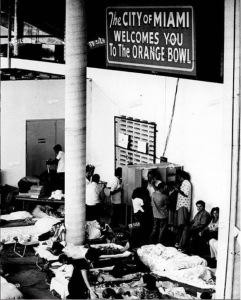
Cuban immigrants in Miami used the invasion of the Peruvian Embassy in Havana and the subsequent Mariel boatlift to build a multigenerational front against communism across the hemisphere. For, without disciplined repetition of anti-communist devotion, how would the threat of communism be legitimized outside the island? On April 7, 1980, over three thousand Cuban immigrants celebrated as city commissioners Maurice Ferré and Armando Lacasa phoned President Jimmy Carter, demanding that an estimated ten thousand Cubans be granted the ability to migrate to Miami.[11] On the same day, the commissioners voted to designate the Miami Orange Bowl as an official donation site, where food and clothing would be collected for the new wave of Cuban migration. After this vote, hundreds of Cuban immigrants crowded outside City Hall to hear Commissioner Lacasa and multiple other speakers from the building’s balcony. [12] Along with making the Orange Bowl the “storehouse to aid them,” the stadium, through Assistant City Manager César H. Odio’s efforts, became a site of temporary housing for Cuban immigrants who were initially meant to be sponsored by several Cuban American families, but were abandoned by them once they arrived. [13] On the July 5th, 1980 episode of Montage, Odio was interviewed about the seven hundred Cuban immigrants living on cots under the stands of the Miami Orange Bowl (pictured in photo). [14] He described this new generation as “survivors,” who became “defiant” after being “suffocated, stifled, and frustrated under Castro.” [15] Odio claimed that as this wave of Cuban migration “would hurt the economy of the communist government,” and in turn “became lazy” and accustomed to “being facilitated everything by a communist regime.” He ended his interview with a call to action for older Cuban immigrants, declaring that “we have to educate them that this is a different world, this is a different kind of life.” [16]
Odio’s phrasing of having to “educate” this new generation of Cuban immigrants echoes Aurelio Miranda’s reflections on the stadium as a site where spectators project their interpretations of “national” values upon one another. Yet, suppose we further complicate how and what is being taught in this “classroom.” In this case, we unravel a key objective in this curriculum: how an anti-communist should behave beyond the stadium, including within their work ethic and personal life. Odio’s interview response also makes apparent how disconnected he was from the present reality of the island. Yet, his memories still hold material significance in the livelihoods of this new generation of Cuban immigrants, primarily as this is being broadcast across the city. This interview lays bare how memory is more than recollections and is a powerful mobilizing force that reanimates one of the most substantial facets of the Latin American Right, an unwavering reverence for anti-communism.
A moment within the Miami Stadium that exemplifies these tests of authenticity and commitment projected among anti-communist Cuban immigrants through stadiums is the rally during the 1970 Republican National Convention, which took place in Miami. On February 22nd, Cuban immigrants gathered at the Miami Stadium to draw the attention of Republican government officials to the island. Cuban immigrants declared that they were meeting within the stadium to “tell the world that they would never accept the coexistence of the Castro regime and the free world” and that “while Cuba was under a communist regime, there will be no peace in the American continent.” [17] The rally broadcast displays the stands crowded with people lifting Cuban flags. Children at this rally witnessed people lighting up Soviet flags on the field, with some being encouraged to stand close to the flames and hold up the corners as they tossed lighter fluid across them.[18] The Miami Stadium, illustrated by this rally, acts as a site where anti-communist Cuban immigrants both perform their commitment to the counterrevolution and are simultaneously taught how to instill it into their children and community.
Nearly a decade after this rally, the call for violence against the revolutionary government under the guise of fighting for the free world remained the same. The caravans, rallies, and even commitments to re-educating new generations of Cuban immigrants into exceptional capitalists are all active battlegrounds against socialism, not only on the island but more broadly, against any leftist or progressive project across the hemisphere. These battlegrounds must be analyzed as an extensive, multigenerational, and transnational project, renewed and refreshed across time and place. CIA-trained Cuban immigrants like Luis Posada Carriles, Eloy Gutiérrez Menoyo, and Orlando Bosch are not aberrations within these classrooms but rather exceptions that prove the rule of the Latin American Right’s ever-growing arsenal of counterinsurgent training.
While both the Orange Bowl and the Bobby Maduro Stadium have been demolished, remnants of their existence remain in the construction of the new LoanDepot Park, on the same site as the Orange Bowl, and the naming of the street and park entrances after Bobby Maduro. The anti-communist traditions and routines associated with those earlier stadiums also continue to be practiced within and around the park by a key segment of the U.S. anti-Communist Latine Right. Rather than conceptualizing these events as rooted in the past, I argue that the protests at the 2023 World Baseball Classic Semifinal and the current construction of the Miami Freedom Park, which will serve as the home for Inter Miami CF’s Major League Soccer Team, are all revitalizing acts of counterrevolution. We are witnessing this educative potential of stadiums not only materialized through their unexpected uses and commemoration, but also in the plans for their construction and financing, given that one of the main funders of the entirely privately owned Miami Freedom Park is a son of Cuban immigrant Jorge Mas Canosa, founder of the right-wing and historically anti-dialogue lobbying organization, the Cuban American National Foundation. Nearly seventy years later, we can draw parallels between the Aleman family’s 1940 investments in the Miami Stadium and the Mas family’s current commitment to the future of the Miami Freedom Park in sustaining stadiums as sites for right-wing political action.
Endnotes
[1] Miami Herald, March 18th, 2023, “Cuba’s National Baseball Team’s Game in Miami revives old political battles.”
[2] Jim Buchanan, “Cuban Refugees Protest Against Conciliation Moves,” Miami Herald, February 26, 1973, sec. B, p. 3.
[3] “White Elephant: What Is There to Save? Bonus Material,” 21:26, Vimeo video, uploaded by Andrew Llanes, 2015, accessed January 15, 2025, https://vimeo.com/105882823. For full documentary, visit https://vimeo.com/105767151
[4] “Book III, Prints 81-82: Public Trials of Batistiano Officials,” Cuban Revolution Collection (MS 650), Manuscripts and Archives, Yale University Library, accessed January 14, 2025, https://collections.library.yale.edu/catalog/10018207.
[5] J. Patrice McSherry, “The Víctor Jara Case and the Long Struggle against Impunity in Chile,” Social Justice 41, no. 3 (137) (2014): 55, https://www.jstor.org/stable/24361632.
[6] Perez, Louis A. On Becoming Cuban: Identity, Nationality and Culture. Chapell Hill: University of North Carolina Press, 1999. 75.
[7] “White Elephant: What Is There to Save? Bonus Material,” 21:26, Vimeo video, uploaded by Andrew Llanes, 2015, accessed January 15, 2025, https://vimeo.com/105882823. For full documentary, visit https://vimeo.com/105767151
[8] Jim Buchanan, “Cuban Refugees Protest Against Conciliation Moves,” Miami Herald, February 26, 1973, sec. B, p. 3.
[9] Buchanan, “Cuban Refugees Protest,” sec. B, p. 3.
[10] “Cuban Rally and Motorcade from Orange Bowl to Hialeah, sponsored by Alpha 66 and Bay of Pigs Brigade (06/02/1979),” Wolfson Archives Database, video, 34:18:21, accessed May 12, 2023,https://wolfsonapps.org/search/show_detail.php?db_id=44759&searchtype=QUICK&searchterm_quick=ORANGE%20BOWL
[11] Dan Williams and Ivan A. Castro, “Enthusiastic Exiles Jam Streets,” Miami Herald, April 8, 1980, 1A, continued on 8A, col. , accessed January 15, 2024.
[12] Williams and Castro, “Enthusiastic Exiles,” 8A.
[13] “Cuban Rally and Motorcade (06/02/1979),” YouTube video, 10:15, uploaded by WolfsonArchive, May 1, 2023, affiliated with Wolfson Archives, accessed January 14, 2025,https://www.youtube.com/watch?v=PET7q-Prctw.
[14] “Cuban Rally and Motorcade,” Wolfson Archive, 10:15.
[15] “Cuban Rally and Motorcade,” Wolfson Archive, 10:15.
[16] “Cuban Rally and Motorcade,” Wolfson Archive, 10:15.
[17] “Cubans Rally, Miami Stadium,” video, 06:25:24, broadcasted February 22, 1970, Wolfson Archives Database, Miami Dade College, Accessed May 12, 2023, https://wolfsonapps.org/search/show_detail.php?db_id=169&searchtype=QUICK&searchterm_quick=anti-castro%20rally.
[18] “Cubans Rally, Miami Stadium,” Wolfson Archives, 06:25:24.
Featured Photo Credit: Miami Stadium, Miami, Florida Postcard. 1930-1945. Tichnor Brothers Collection, Print Department of Boston Public Library. CC BY 2.0