
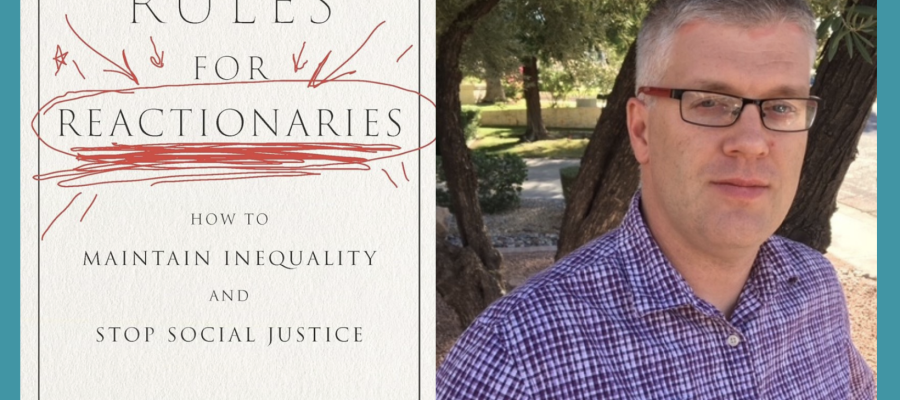
For years I have been waiting for a book that would serve as a contemporary companion to a previous generation of critical whiteness studies like George Lipsitz’s The Possessive Investment in Whiteness (1998), David R. Roedigger’s The Wages of Whiteness (2007), or Eduardo Bonilla-Silva’s Racism without Racists (2021). It is not an overstatement to say that Lee Bebout’s Rules for Reactionaries is a worthy inheritor of these fine books, in no small part due to its updated context and case studies rooted in contemporary manifestations of white supremacy.
Rules for Reactionaries offers a thoroughly researched, elegantly argued, and thoughtfully constructed book. As is evident by its ironic title (it is, in fact, a takedown of the revanchism of the current moment), the book also offers a good bit of humor. It is a fact that the rise of the alt right and neo-fascism, online troll culture, and seemingly benign forms of racist speech like “whataboutism” have defied the traditional analytical and cultural tools of anti-racist scholarship and activism. To borrow a phrase from Marshall Berman, contemporary forms of white supremacy are always ‘melting into air,” disappearing in the form of racist jokes, passive/aggressive disidentification, and assertions of racial innocence. Although no single book can provide the answer to these multimodal and complex forms of white supremacy, Rules for Reactionaries offers an essential resource for critical ethnic studies practitioners.
Bebout’s work considers the rhetorical structures of argument that underpin contemporary forms of white supremacy. Where texts like Lipsitz’s, Roedigger’s, Bonilla-Silva’s, and others like Omi and Winant’s Racial Formation in the United States (1986) provide critical language and analytical frameworks for understating structural racism, Bebout focuses on the (sometimes softer) ways racism operates through culture, the news, and often at the level of interpersonal relations. This focus on rhetorical strategies aids in understanding underlying messages of white supremacy that are conveyed through coded and implied forms of speech and action. In other words, the book provides analytical tools for understanding both how white supremacist sentiments are disseminated through Fox News or the so-called manosphere, and how people uncritically adopt racist ideas they see on social media or via other media forms.
The nuance with which Bebout unpacks these moments of bad faith is crucial. Like his intellectual predecessors, Bebout encourages readers to think beyond racism as a category rooted in individual instances of overt racism. Combatting what he terms the “folk theory of racism” that freezes racist behavior and ideas within a static identity (one is either a racist or not), Rules for Reactionaries encourages readers to instead understand racism as a terrain people inhabit and can traverse throughout a discourse transaction:
I find it more useful to conceptualize systemic injustice taking the shape of discursive, ideological, and sociopolitical terrain. Rather than fixing ourselves and others within a binary or triad framework, the metaphor of terrain allows us to recognize that we occupy various positions throughout our lives. The terrain itself is not fixed but always shifting beneath our feet and transforming through our actions, even when, like erosion, we do not see the immediate impact. (46).
The idea of shifting racism away from static positions and toward a mobile terrain is liberating. This metaphor is important for responding to the inevitable confrontation many anti-racist practitioners experience when a person we care about, or a student utters an idea that upholds social inequality. By focusing on terrain and movement, it is possible to respond productively, outside of the usual ad hominem attacks that characterize the dissolution of discourse in the popular imaginary. In short, Bebout’s book provides tools for responding to racist ideas, rather than reacting to them. Instead of freezing a racist or sexist idea or action in an identity, Bebout advocates for understanding the terrain as one we inhabit—and can therefore move away from. This is a hopeful framework for thinking about racism. If it is possible to move into such regressive positions, it is also possible to move out of them. Although the work of moving out of the terrain of social inequality is difficult, it is possible to conceive of movement toward more socially just coordinates.
The book’s rejection of dialog as a necessarily transformative mode of discourse is also refreshing. Championed by many in the public sphere—including academic administrators who are under pressure to provide fora for so-called ideological diversity—the idea of discourse implies that it is possible to “quickly [change] the minds of others through correct logic and magic words” (199). Such a logic suggests that it is not only possible, but a laudable goal to change people’s minds. Anyone who has confronted a relative or family friend committed to social injustice at the dinner table (Bebout imagines this figure as “Uncle Harry”) understands that strategies designed to change an interlocutor’s mind more often lead to both parties entrenching themselves in their disparate positions. Rules for Reactionaries questions the notion of persuasion as a form of what Lauren Berlant describes as “cruel optimism”—or the idea that we crave forms of speech or objects of desire that are harmful to us. In contradistinction to this view, Bebout explores a variety of models for disrupting our simplistic ideas of dialog as transformation by emphasizing “rhetorical listening,” “consubstantial identification,” seed planting, and recognizing the presence of secondary audiences where anti-racist ideas might flower.
When I first started reading the book, I was a little surprised that it didn’t draw more (if not ALL) of its case studies and examples from the field of Latinx Studies. Bebout is a well-regarded Chicanx and Latinx Studies sScholar with two books and many articles that have become central to the field. Although Rules for Reactionaries does an admirable job of thinking about issues around immigration, sexism and anti-LGBTQ+ sentiment within Latinx communities, it more often focuses on a variety of examples, from the 1776 Project (issued by the Trump Administration in 2020 as a response to Nikole Hannah Jones’s 1619 Project), to advocacy for equal pay by the United States Women’s National Soccer Team. While the broad focus on social inequality might at first glance appear to be a deviation from Latinx Studies, Rules for Reactionaries bridges Latinx Studies with other race and ethnic studies fields. Along the way, it makes connections with aligned fields like Women’s and Gender Studies, LGBTQ+ Studies, and Disability Studies—to name just a few. By studying similarities between the rhetorical strategies that bad faith actors deploy at many points along the political spectrum, the book helps readers to understand how signatories to white supremacy and other forms of social inequality draw from similar rhetorical playbooks. Such a move enables practitioners to avoid the cycles of outrage and counternarrative, allowing readers to, in Bebout’s words, “recognize rhetorical patterns and call attention to them as a means of disruption” (187). In Bebout’s terms, such moves facilitate shifting terrains away from, for example, bad-faith debates about “illegal immigration,” to more robust and nuanced discussions about the long history of migration between Latin America and the US (or the fact that large swaths of the US were at one time Latin America!), the root causes of migration in climate change, war, and US intervention, or the colonial status of Puerto Rico. The emphasis on rhetoric facilitates a shift to more favorable terrains for argument where it is possible to ask better questions, to historicize, and to provide alternative frameworks for generating knowledge.
It is important to note that persuasion is not one of the hoped-for outcomes of the types of rhetorical engagement that Bebout imagines. Like Bebout, I have come to appreciate forms of engaged dialog without an attachment to conversion or transformation. I am persuaded that engaging in rhetorical exchange in the mode of Luce Irigaray and Michael Marder’s Through Vegetal Being (2016)—a text that proceeds from the standpoint of dialog based on incommensurability, rather than transformation—is a more productive framework for argument. Rather than seeking to vanquish, subdue, convert, or transform one’s interlocutor, approaches like the one Bebout advocates in Rules for Reactionaries advocate for critical forms of engagement, listening, and compassionate conversation. This is not to say that in my reading Bebout gives up on the idea of social transformation. Rather, as Rules for Reactionaries argues, “we participate in these conversations as one form of struggle, and we struggle for a more just world because the other alternatives are simply not acceptable” (199).