
La antropóloga y lingüista boricuo-mexicana Ana Celia Zentella (Zentella et al., forthcoming; Figueroa, 2016) nos recuerda que el lenguaje y las prácticas lingüísticas son siempre, inherentemente, un ejercicio de poder. Decido entonces comenzar este ensayo en español, el idioma de mis padres, de manera intencional, para ahincar el punto de partida (literal y simbólico, cultural, geográfico, y político) desde donde comienzan los ires y venires, la trayectoria, el vaivén (Duany, 2002) y el “lleva-y-trae” que describo en estas notas biográficas con implicaciones sociológicas. Lo que les cuento hoy importa, no porque sea una historia única, sino todo lo contrario, porque es común. Porque de alguna forma es la historia de muchos/as/es otros/as/es boricuas que comparten mis coordenadas sociales e históricas.
DEPARTURE
I switch registers now to begin tracing the conditions that produced my departure. 1993 was the year in which I made the decision to leave la isla/el archipiélago, pushed in large part by my material conditions. To provide necessary context, I grew up in a working-class household, and since my early college years was self-reliant financially. Admittedly, the term self-reliance might be a bit of an overstatement. To be accurate and frank, my ability to reliably cover necessities was always unstable. But I managed to get by, and by the grace of all that is good (perhaps because “yerba mala no muere nunca”) I completed my BA in Sociology in 1992. Following graduation, I stayed in the same “hospedaje” in which I’d lived as a student. I supported myself by combining food stamps and working as a research assistant in sporadic research projects in the Center for Applied Social Research (CISA, for its acronym in Spanish) at the University of Puerto Rico, Mayagüez (UPRM). When funds from the last research project dried up, to cover rent and other bills, I took out a loan from a small local lender that, evidently, and thankfully, did not realize I was at high risk of defaulting because my income, tied as it was to research project cycles, was irregular.
During those days of the “vacas flacas,” I applied for all sorts of jobs and took numerous tests required to qualify for entry-level government jobs at which I imagined I could put my sociological skills to use. After months of failed job searches and ongoing financial precarity, and with a loan that I was supposed to begin repaying soon, it dawned on me that I should probably consider the advice of my mentor, boss, and friend, Dr. Manuel Valdes-Pizzini, and try to get into graduate school. Supportive professors from UPRM’s Social Sciences department shared information about a program that existed back then, geared towards increasing the numbers of “minoritized students” In US graduate programs. One had just to fill out one application that they would then send to graduate programs in up to 10 of their partner institutions. And they covered the application fee. Application deadlines for many graduate programs had already passed, but there were a handful of programs still accepting applicants. So, I applied to those and crossed my fingers. Long story short, several weeks later, one said program accepted me and offered me a paid teaching assistantship. I could go to graduate school, get a place to stay (in the dorms), and have money for food. They also offered to pay for my airfare, so I could actually get there. The “choice” was made. The same year this was all unfolding, Magali García Ramis published her essay titled “Los cerebros que se van y el corazón que se queda” (García Ramis, 1993) .…
Historian Jorell Melendez-Badillo begins his prologue to the book Puerto Rico: Historia de Una Nación(2024) with a quote by author Jose Luis González, which is pertinent here. “La realidad puertorriqueña es una realidad caótica en muchos aspectos, sí, pero la tarea del escritor consciente es la de arrojar luz sobre el caos, no la de retratarlo simplemente.” So, in that spirit, I offer the following interpretation of my own experience. While some would describe my “choice” to leave PR for the United States as an instance of voluntary migration, it is more accurate, from a critical standpoint, to describe my exiting as an instance of colonial displacement imbricated by class. In other words, US colonialism, deeply intertwined with capitalism as it is, created the so-called “push” and “pull” factors, as well as the available paths for my journey. As Harsha Walia (2013) forcefully argues, “migration is not a choice when the conditions that compel movement are created by colonialism (and) capitalism….” This is a point that has become clearer to me over time, and that I have sought to emphasize in my own work on power and mobilities and immobilities across the globe (see Maldonado and Bickham Mendez, 2026). Significantly, my journey is one that is not at all unique, but in fact, is the journey of many poor and working-class Puerto Ricans who were lucky enough to get toolsthrough a high-quality education at la universidad del pueblo (Puerto Rico’s public university) to pursue a “better” future—or at least a less precarious livelihood.
Inscribed in my heart and mind the summer before my departure were a mix of excitement about new possibilities, an undeniable fear of the unknown, and a profound sense of loss connected to what my astute compueblano, Bad Bunny (2022), has identified as the geopolitical mantra of the proud sons and daughters of our soil, “Yo no me quiero ir de aqui.” But summer came and went, and in August of 1993, it was time to leave.
(UN)SETTLING[1] STATESIDE
I left from San Juan. It took multiple planes and an ungodly number of hours, but I eventually landed in Spokane, Washington. One of the professors at my new university (Washington State) picked me up at the airport and drove us an additional two hours to Pullman, in the agricultural region known as the Palouse. The ride seemed interminable, and the landscape I encountered upon arrival contrasted sharply with the island landscape I had known until then. I remember feeling that I was the farthest I could be from where I belonged. Immediately, I began experiencing the cultural, linguistic, and social dislocations Puerto Ricans (and other migrants from Latin America) face when they move North. The local “context of reception” (to use language from migration research) on the eastern side of Washington State chilled me to the bone—literally and figuratively. My experiences in subsequent years were delineated by the social, demographic, and geographic characteristics of this context: an overwhelmingly white rural region with a negligible number of Puerto Ricans, if any, and only slim numbers of other racially minoritized populations. I used to joke that my sole presence there increased the Puerto Rican population by 300%. It was there that I semi‑reluctantly took on the label and identity of “Latina” to make everyday interactions easier for myself and others. I was often presumed to be Mexican, because in Eastern Washington at the time Puerto Ricanness was largely illegible. Over time, my Puerto Ricanness became my race—my self‑claimed ethnoracial identifier—as I began to understand, sociologically, how race structures identity and social relations in the US, and how racialization is implicated in the workings of empire and the subordination of colonized peoples, myself included.
Although a deep dive into the peculiarities of navigating life as a brown working‑class Puerto Rican woman in a small, overwhelmingly white college town lies beyond the scope of this essay, one larger point bears noting. The expanding geography of the Puerto Rican diaspora demands that scholars pay closer attention to how different places, beyond the historic hubs of Puerto Rican migration (New York, the Eastern Seaboard, Chicago, and the Midwest) —with their racialized, gendered, and classed histories and politics—shape Puerto Rican experiences and political subjectivities.
The colonial displacements that produce different waves and generations of Puerto Rican diaspora also generate resistances, and embodied politics through which boricua brains and hearts re-imagine and (re)create connections to our archipelago, and new ways to live Puerto Ricanness are enacted wherever we are, inflected with the sociopolitical particularities of our new “homes away from home.” To be sure, class, and more accurately, intergenerational wealth (or the lack of it) continues to mediate mobility and the possibility of actually “traveling home” (for a useful entry point into the the enduring ways in which class continues to shape the lives of academics, see Ardoin and Martinez, 2019). Traveling to PR from the faraway places where I’ve found myself for the past thirty-some years (Washington, Iowa, and more recently, Oregon) has been expensive and often out of reach. For many years, I’ve also had to work summers to pay bills. A colleague recently commented that she was struck by how some of her Puerto Rican students go home all the time, several times a year. And it only recently dawned on her that these students come from wealthy families. Since I left, I’ve only been back to “visit” PeErre five times at most. In fact, I prepared these remarks in their original form for a conference in Puerto Rico, so I could use the opportunity to go home and see my dad, whom I’d not seen in more than ten years. The physical separation from the land and coasts that I call home and my infrequent trips there constitute a form of imposed family separation and “geographic dispossession” that hurts and will forever hurt. But it has also fueled a personal politics of anger and resistance. My connections to PR are in many ways stronger, because I reflect on them constantly and work intentionally to maintain them across the spatial divide. Having lived in the United States has also shaped my consciousness and specifically my anti-imperial, anti-colonial, anti-racist, and anti-capitalist politics in ways I did not anticipate. Life in the US as part of a racialized Puerto Rican diaspora and my academic journey as a sociologist “from the periphery,” whose questions of interest were and continue to be shaped by the context in which I grew up, led me to uncover important political synergies and connections, like for instance, those among Puerto Rican experiences of displacement, dispossession and second-class citizenship, the historical and ongoing displacement and dispossession of Native American and Black communities, and the routine exploitation of racialized immigrant labor in the United States. Exploring these connections, of course, has also revealed new spaces and possibilities for community-building, solidarity, and resistance beyond national borders.
THE (IM)POSSIBILITY OF RETURNING
In a sense, the Puerto Rico I left three decades ago is no longer. The structural forces that propelled my exit, and those of so many others, have not disappeared. They have deepened, accelerated, and taken new forms, steadily eating away at the conditions that make it possible for ordinary people to remain and make a life at home. Austerity, deteriorating infrastructure, privatization, and governmental neglect have accumulated upon one another, making the everyday labor of sustaining a life in Puerto Rico increasingly difficult. And when I confront what this all means–it breaks me to admit it– I fear there may be no way home for me anymore.
But that is not the whole story. I find hope every time I learn about the relentless efforts of Puerto Ricans to reclaim and protect what is ours, and to create something different: in university students who protest; in Las Playas Son del Pueblo and the struggle to defend our beaches; in the movement of opposition to Esencia; in Casa Pueblo’s work in Adjuntas; in the agroecological movement and its commitment to sustainable, locally rooted agriculture; and in the intersectional community organizing of the Colectiva Feminista en Construcción. These movements, their proposals, their vision, the people who give them life, renew my hope. They allow me to imagine that the possibility of another Puerto Rico remains alive. They make me think that, one day, I might still find my way back home.
As I close these anecdotal notes, as a way to close the circle between my fear and my hope, I return to Spanish, el lenguaje en el que hablo con mi papi por via telefónica los domingos. En ese lenguaje cabe la fantasía más linda, una casita en el campo con un balcón bien grande y una hamaca. Gallinas en el patio, y un gallo vocífero que reemplace la alarma. Matas de plátano, y un palito de pana. Abro la pluma y lavo mi taza de café. Casi nunca se va la luz.
Endnotes
[1] I use the term (un)settling deliberately to trouble the notion of “settlement” or “settling.” On the surface, settling suggests a smooth or uncomplicated process of establishing oneself in a place—an assimilationist narrative that obscures the racialized dynamics and sociocultural frictions that shape Puerto Rican life in the United States. More importantly, the language of settlement risks equating Puerto Rican displacement with voluntary migration, masking the colonial conditions that produce it (Lugo-Lugo and Bloodsworth-Lugo, 2025; Melendez-Badillo, 2026). The parenthetical “un” signals this tension: the simultaneous pressure to settle and the impossibility of fully settling within structures that have already rendered Puerto Ricans displaced, mobile, and out of place.
Author Biography: Marta María Maldonado is Associate Professor of Ethnic Studies at Oregon State University
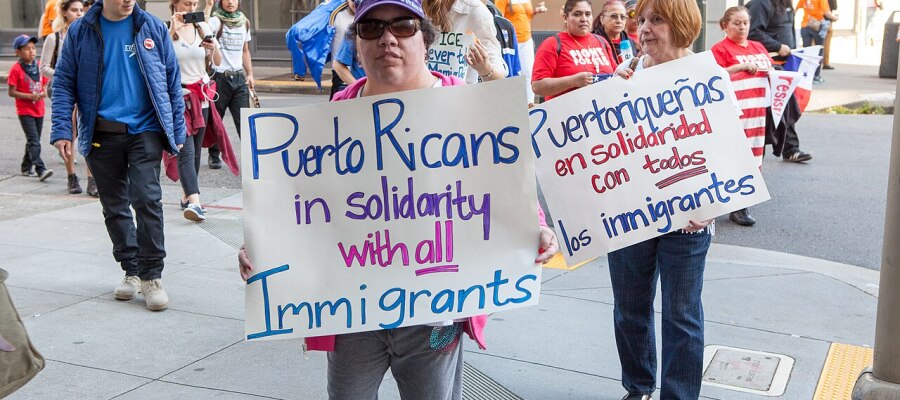
Featured Photo Credit: “May Day 2017 in San Francisco” by Pax Ahimsa Gethen on Wikimedia Commons, CC BY-SA 4.0

References
Ardoin, Sonja, and Becky Martínez. 2019. Straddling Class in the Academy: 26 Stories of Students, Administrators, and Faculty from Poor and Working-Class Backgrounds and Their Compelling Lessons for Higher Education Policy and Practice. New York:Routledge.
Bad Bunny. 2022. “Yo no me quiero ir de aquí.” Un Verano Sin Ti. Rimas Entertainment.
Duany, Jorge. 2002. The Puerto Rican Nation on the Move: Identities on the Island and in the United States. Durham, NC: The University of North Carolina Press.
Figueroa, Yomaira C. 2016. “The Life Work of Ana Celia Zentella: AnthropoliticalLinguistics, Bilingualism, and Linguistic Communities at a Crossroads.” Centro Journal XXVIII(I) (Spring).
García Ramis, Magali. 1993. “Los cerebros que se van y el corazón que se queda.” La Ciudad Que Me Habita. Río Piedras, Puerto Rico: Ediciones Huracán.
Lugo-Lugo, Carmen R. and Mary K. Bloodsworth-Lugo. 2025. “Managing Life and ManagingDeath: The Commonwealth of Puerto Rico, Bio/Necropolitical Production, and a New Wave of Settler Colonialism.” Settler Colonial Studies 15(4): 646-662.
Maldonado, Marta Maria and Jennifer Bickham Mendez. 2026. “Critical Interventions inStudies of Human (Im)Mobility: Race, (Settler) Colonialism, and Empire.” Introduction to the Special Issue Critical Perspectives on Racialized (Im)Mobilities and the Politics of Belonging, Ethnic and Racial Studies (Forthcoming).
Meléndez-Badillo, Jorell. 2026. “Puerto Rican Studies as Caribbean, Latin American, and Diasporic Knowledges.” In Aurora Santiago Ortiz and Jorell Meléndez-Badillo (eds.), Interrogating the Future of Puerto Rican Studies. Durham, NC: Duke University Press.
Meléndez-Badillo, Jorell. 2024. Puerto Rico: Historia de una Nación. Planeta Publishing.
Walia, Harsha. 2013. Undoing Border Imperialism. Oakland, CA: AK Press.
Zentella, Ana Celia, Adam Schwartz, Bonnie Urciuoli, and Cristian Aquino-Sterling. Forthcoming. Language, Identity and Justice: The Anthropolitical Worlds of Ana Celia Zentella. Bristol, UK: Multilingual Matters. (November 2026.)