
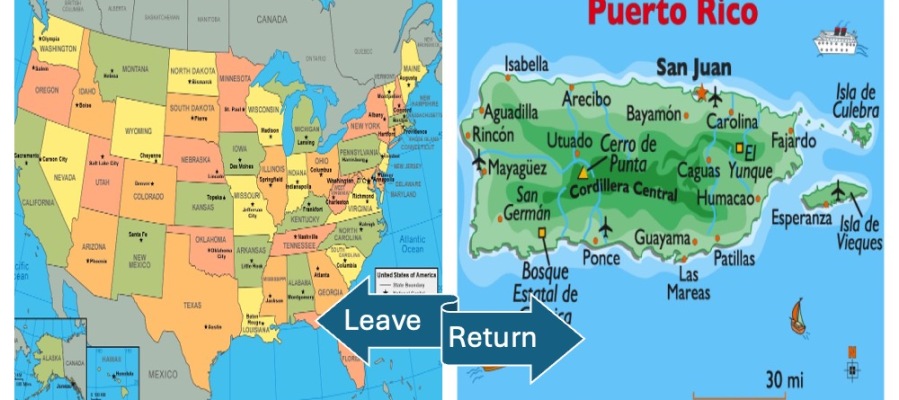
The baggage that comes with being a diasporic subject hits every Puerto Rican abroad differently, and yet, there are underground tunnels and currents that connect that experience for all. That’s because embedded within that baggage, and part of the cultural lore in the Puerto Rican archipelago, are certain ideas about leaving to and living on the mainland. First, people on the islands collectively speak about Puerto Ricans who leave for the U.S as “se fueron pa’ fuera” (they went outside) and to those who live in the U.S. as “viven afuera” (i.e., they live outside). This particular construction of going or living outside, Jorge Duany (2001) conveys, suggests a clear distinction between “an external perimeter” (invoked in the word “outside”) juxtaposed to “an internal nucleus” (with the implied “inside”) “giving [the phrase and its implication] a sense of national place, culture, and identity” (my translation, 42).
Popular culture, especially popular songs have also created specific narratives about leaving the islands and living outside. Always reflecting their historical time, I can offer three particular examples. First is the idea that Puerto Ricans may be leaving “but one day they will return” (i.e., “pero un día volveré”), as Noel Estrada says in his song “En mi Viejo San Juan.” Written in 1942, as Puerto Rican soldiers were drafted by and fighting for the US in WWII, and as the first massive wave of immigration from the islands to the US was beginning to shape up, the song became the unofficial anthem of the Puerto Rican diasporic subject. Another idea was captured by the rock band Fiel a la Vega over 50 years later in their song “El wanabí,” which talks about the audacity of wanting to prove oneself in the US, concluding that if that desire didn’t mean anything “there wouldn’t be a [Roberto] Clemente, there wouldn’t be a [Raúl] Juliá” (si nada de esto significara algo, no habría un Clemente, no habría un Juliá). Written in 1996, and part of the soundtrack for the Puerto Rican film Una noche en Hollywood (A Night in Hollywood), the song reflects times of modest economic growth and ambition in Puerto Rico. The final and most recent example is that of Bad Bunny’s song “Lo que le pasó a Hawaii,” which dropped in 2025 and talked about another jíbaro who “no quería irse pa’ Orlando, pero el corrupto lo echó (didn’t want to move to Orlando, but the corrupted one—i.e., the governor, threw him out).
Beginning next week, and over the next five weeks, we will publish a new series of essays and articles on this topic, titled “Reflections on Puerto Rican Diaspora.” We understand that while we will never have a full picture of diasporic Puerto Ricans, the essays in this series—all written by authors born in Puerto Rico who later left (“se fueron pa’ fuera”)—contribute to an ongoing discussion on this topic. This work was originally presented in a panel organized for the 2025 LASA Puerto Rico section, which took place at the University of Puerto Rico Mayagüez Campus (UPRM). They have since been peer reviewed and revised. Coming from different perspectives and varied lengths of time spent in the diaspora, these essays give us a glimpse of what the diaspora feels like for the members of one particular group: diasporic scholars—four still living in the U.S., and one who returned to Puerto Rico after retirement.
Essays and articles in the “Reflections on Puerto Rican Diaspora” series will begin next week and continue over the next five weeks. We look forward to your comments!
Author Bio: Carmen R. Lugo-Lugo is a Professor of Comparative Ethnic Studies and American Studies and Culture at Washington State University, Vancouver.