
Indigenous cultures rarely appear in the media on their own terms. When they do, they often take the form of caricature or stereotype. For decades, television and popular entertainment have portrayed Indigenous characters through exaggerated accents, rustic manners, or naïve personalities. When they are not treated as objects of humor, Indigenous cultures are often framed as relics of the past. In documentaries and tourism campaigns, they appear as vestiges of ancient civilizations associated with ruins and archaeological sites.
Due to colonial legacies and ongoing discrimination, national narratives across Latin America have often treated Indigenous languages and knowledge systems as historical artifacts rather than living practices (Mendoza-Mori 2025). These assumptions continue to shape how Indigenous peoples are represented in contemporary media.
These patterns also shape how Latinidad itself is imagined in popular culture. In much of mainstream media, Latin American and Latino identities are presented through simplified narratives that leave little room for Indigenous languages, cultures, or histories. This invisibility is particularly striking given contemporary demographic realities. Indigenous peoples from Latin America represent one of the fastest-growing yet least visible populations in the United States. Yet many Indigenous migrants continue to be categorized simply as “Latino” or “Hispanic,” diluting important linguistic and cultural differences (Gonzalez-Quizhpe and Mendoza-Mori 2026).
In that context, Apple TV’s Pluribus becomes a revealing example. Released in 2025, the science-fiction series features Kusimayu, a Quechua-speaking teenager from the Andes. Her presence may seem like a small detail within a global streaming production, but it raises larger questions about who is imagined as part of Latinidad, who is imagined as part of the future, and which languages are allowed to occupy space in popular culture.
Some recent productions have begun to challenge older patterns of representation. The acclaimed series Reservation Dogs (2021–2023), created by Sterlin Harjo and Taika Waititi, offered a powerful example of U.S. Native-centered television, portraying everyday Indigenous life with humor, complexity, and community-based perspective. Still, Indigenous languages from Latin America, a region many Indigenous movements refer to as Abya Yala (Keme and Coon 2018), remain especially rare in global pop culture. This limited visibility also extends to media circulation more broadly: Indigenous audiovisual productions from Latin American regions remain scarce in educational and other distribution channels (Ibacache and Aguilera 2026).
Rather than appearing in isolation, Pluribus forms part of a small but noticeable build-up in global pop media’s engagement with Quechua and Andean cultures. Recent Hollywood films such as Transformers: Rise of the Beasts (2023) and Dora and the Lost City of Gold (2019) have included Quechua-speaking characters and broader references to the region. Pluribus continues this trajectory, making it a useful occasion to ask what happens when Quechua enters global science fiction and circulates through mainstream streaming platforms.
In Pluribus, an extraterrestrial virus transforms humanity into a collective consciousness. Most people become part of a society that appears harmonious and free of conflict, while thirteen individuals remain immune for reasons the series has not fully explained. These survivors are not presented as primitive holdovers or enemies of the new order, but as ordinary people from different parts of the world whose continued individuality unsettles the promise of a unified collective. One of them is Kusimayu, a Quechua-speaking character living in the mountains of Peru.
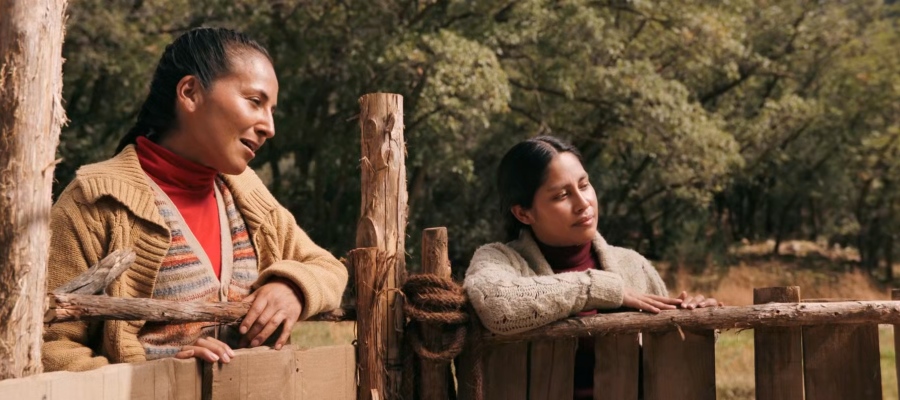
Kusimayu is played by the New York-based Peruvian actress Darinka Arones. Her cultural identity is woven into the narrative world of the show rather than treated as an exotic detail. The production worked with cultural consultants including Quechua professor Doris Loayza of the University of Colorado and award-winning poet Irma Álvarez-Ccoscco, and features two additional Quechua-speaking actors, Jennifer Esquivel and Elena Éster.
The presence of Kusimayu raises a broader question: how can Indigenous cultures be represented within stories designed for global audiences? In recent years, filmmakers in the Andes have explored this challenge through locally grounded stories told in Indigenous languages including Killa (Ecuador, 2017), Willaq Pirqa (Perú, 2022), Utama (Bolivia, 2022) and Runa Simi (Perú, 2025). These films approach Indigenous languages from local perspectives, often centering Andean communities and stories. Pluribus enters from a different direction: it is a global streaming production with a broader science-fiction plot, yet it still features a Quechua-speaking character. Without giving away spoilers, the series presents Quechua as part of a contemporary, even dystopian, world. For the show’s official podcast, Arones has emphasized that Andean culture cannot be reduced to Machu Picchu or the Inka past. Quechua is also a living culture spoken by millions today.
That representation matters because Indigenous peoples have often been imagined as belonging to an earlier historical moment. As Peruvian historian Cecilia Méndez (1995) famously summarized regarding Peru’s national imagination, the message has often been “Incas yes, Indians no.” Contemporary Indigenous peoples and their demands remain marginalized. Similar tensions continue to shape representations of Indigenous communities throughout the Americas.
Scholars of Latinx culture have long examined how identities are shaped by markets, media, and institutions. In her book Latinos Inc., Arlene Dávila (2001) argues that Latinidad in the United States has often been packaged in ways that simplify its internal diversity. Latino identity is frequently presented through a generalized image that privileges a mestizo aesthetic while leaving Indigenous cultures largely invisible. These narratives also tend to assume Spanish as the defining language of Latinidad, leaving little room for Indigenous languages such as Quechua. Blackwell, Boj Lopez, and Urrieta’s (2017) work on Critical Latinx Indigeneities helps name this tension by showing how Indigenous histories, languages, and migrations complicate pan-ethnic understandings of Latinidad. Chón et al. (2022) similarly argue that Indigenous Latinx communities are often rendered absent even when physically present within educational and public institutions. Together, these works reveal the limitations of frameworks that treat Latinidad as culturally or linguistically homogeneous.
Quechua is often imagined through images of Machu Picchu and rural Andean communities. Yet contemporary Quechua life extends far beyond those spaces. Due to different waves of migration in the twentieth and twenty-first centuries, Quechua speakers have established communities across the globe while continuing to adapt their cultural practices to new diasporic contexts.
Work on Quechua diasporas has documented communities in the Washington, D.C. area, where migrants sustain cultural, linguistic, and social ties across the Andes and the United States (Strunk 2015). In New York, Kichwa and Quechua organizations organize cultural festivals, language workshops, and livestreamed events that connect audiences across Ecuador, Peru, Bolivia, Spain, and the United States. These realities challenge longstanding assumptions about where Indigenous languages belong. Migration has transformed Quechua into a transnational language whose speakers increasingly navigate Indigenous, Latine, and U.S. American identities simultaneously.
This question of where Quechua belongs also resonates with the premise of the show. Pluribus imagines a world in which humanity converges into a single collective consciousness, dissolving many of the differences that distinguish individuals and communities. For Indigenous communities, concerns about homogenization are not merely speculative. Across the Americas, assimilationist projects have long sought to erase Indigenous languages and identities in the name of national unity, modernization, or social integration. The tensions dramatized in Pluribus echo longer histories in which linguistic and cultural difference has often been treated as a problem to overcome rather than a resource to value.
From that perspective, Kusimayu challenges assumptions about who belongs in the future imagined by global science fiction. In a world that increasingly pushes toward uniformity of identities, languages, and ways of life, hearing Quechua in Pluribus suggests another possibility. Rather than disappearing, Indigenous languages and cultures continue to shape contemporary life.
Digital platforms further illustrate this transformation. Because Indigenous languages have historically received limited space in traditional media, many creators have turned to social media to make their communities visible on their own terms. Across TikTok, Facebook, Instagram, and streaming platforms, Quechua creators share language lessons, livestream festivals, discuss migration, and document everyday life.
As one participant in a recent study on Quechua digital content explained, “The fact that they see the written language means that my community is present and my language is present” (Thakur, 2025). Visibility is about more than representation. It is also about recognition and affirming that Indigenous languages remain part of contemporary life.
The slow but growing visibility of Quechua in global media reveals a difficult tension. In a market saturated with similar cultural products, cultural difference can become valuable precisely because it appears distinctive. Yet what global media may celebrate as difference is often rooted in long histories of exclusion and marginalization. For that reason, examples like Pluribus should be read with both openness and caution. They can complicate simplified narratives of Latinidad and remind audiences that Latin America and its U.S. diasporas have always been multilingual and multiethnic. But international visibility should not reduce Indigenous cultures to aesthetic resources for global consumption, nor should it distract from the inequalities and linguistic marginalization that continue to affect Indigenous communities in their home regions and in the diaspora.
A Quechua-speaking character in an international production like Pluribus reminds audiences that the language is not merely part of the past. It is a family language of the present, spoken by ten million people across the Andes and throughout diasporic communities around the world; a language of families, communities, classrooms, digital spaces, and cultural futures.
In a world that pushes toward homogenization, Latinidad itself may need to remember something fundamental: its future will not lie in cultural uniformity, but in embracing the diversity that has always shaped it. The question is not whether Indigenous languages belong in that future. Communities across Abya Yala and its diasporas speaking Quechua, Purépecha, Kaqchikel Maya, and other Indigenous languages are already helping create it. The challenge is whether our media, institutions, and public narratives are prepared to recognize them.
Featured Photo: Scene featuring actor Jennifer Esquivel as Sisa and actor Elena Estér as T’ika, Kusimayu’s family in Pluribus, from Movies & TV website.
Author: Américo Mendoza-Mori is an Assistant Professor of Romance languages at St. Olaf College in Northfield, Minnesota. He is an interdisciplinary scholar whose research focuses on Latin America, U.S. Latinidades, and Indigeneity.
References
Blackwell, Maylei, Floridalma Boj Lopez, and Luis Urrieta Jr. 2017. “Special Issue: Critical Latinx Indigeneities.” Latino Studies 15(2): 126–137. https://doi.org/10.1057/s41276-017-0064-0
Chón, David W. B., Luis Urrieta Jr., et al. 2022. “Presencing While Absent: Indigenous Latinxs and Education.” In The Handbook of Latinos and Education.
Dávila, Arlene. 2001. Latinos Inc.: The Marketing and Making of a People. Berkeley: University of California Press.
Gonzalez-Quizhpe, Luis, and Américo Mendoza-Mori. 2026. “Understanding and Supporting Indigenous Latine Students and Their Families”. Immigration Initiative at Harvard Educator Brief, vol. 4, no. 2, June 2026.
Keme, Emil, and Adam Coon. 2018. “For Abiayala to Live, the Americas Must Die: Toward a Transhemispheric Indigeneity.” Native American and Indigenous Studies 5(1): 42–68. https://dx.doi.org/10.1353/nai.2018.a704738.
Ibacache, Kathia, and Arthur Aguilera. 2026. “Voices from the Field: Library Acquisition Pathways for Indigenous Audiovisual Media.” Library Resources & Technical Services 70(1). https://doi.org/10.5860/lrts.70n1.8616.
Méndez, Cecilia. 1995. Incas Sí, Indios No: Apuntes para el estudio del nacionalismo criollo en el Perú. Lima: Instituto de Estudios Peruanos.
Mendoza-Mori, Américo. 2025. “Indigenous Knowledge Systems and Public Humanities: Ayni as Community Engagement.” PMLA 140(1): 160–166. https://doi.org10.1632/S0030812925000082
Strunk, Christopher. 2015. “Practicing Citizenship: Bolivian Migrant Identities and Spaces of Belonging in Washington DC.” Journal of Intercultural Studies 36 (5): 620–39. https://doi.org/10.1080/07256868.2015.1072910.
Thakur, Dhanaraj. 2025. Moderating Quechua Content on Social Media. Center for Democracy & Technology.