
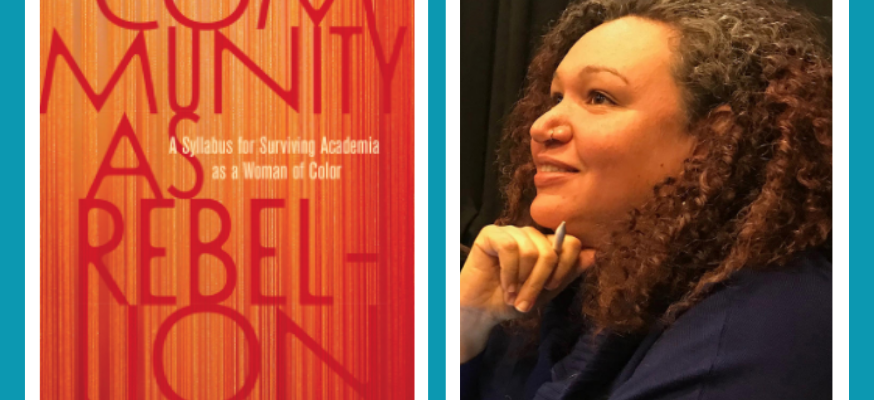
Now more than ever, we need Lorgia Garcia Peña’s Community as Rebellion: A Syllabus for Surviving Academia as a Woman of Color (Haymarket Books, 2022). When I first read this book, I tried to convince myself that while the public institutions I have worked at had their problems, the Ivy League context that Garcia Peña (re)exposes seemed so much worse. However, under Trumpian authoritarianism complete with retribution aimed at institutions of higher education and education as a public good, in general, all our universities can and already do have similarities with the landscape that Community as Rebellion describes. As the author lays bare the pain of being a ‘‘Band-Aid’ [universities] hope to put on their hemorrhaging racial wounds,” she also gives us the key to our survival: community (7).
Her work comes on the heels of Presumed Incompetent II (2020). The second edition of the groundbreaking title of the same name (2012) plainly and thoroughly revealed the structural barriers that actively harm women of color in the academy. Though Presumed Incompetent I and II remain the most comprehensive view of women of color experiences in the academy, Garcia Peña’s work gives us a shorter, more accessible way to engage with many of the same themes in those larger works. She also actively draws on women of color feminisms for the solutions to our isolation and oppression. Modeled after a syllabus with chapters entitled “Course Objective,” “Reading List,” “Midterm,” and “Final Exam,” this one-hundred-page guide covers being “the One” and only person of color in a unit; complicity with whiteness; teaching; and the importance of ethnic studies. Using a syllabus as a framework complete with an opening page that has “course requirements,” “recommended aids,” and “further reading” is an ode to the way she is sharing knowledge with her community, just as she does in classrooms.
The author reminds us that our liberation will not be found in institutions of higher education that were not built for us and have actively harmed our communities in the past. Given this, she admits: “It is an insurmountable task to work, care, teach, and produce knowledge while living and working in this violence. And yet we do, and we must.” Thus, community becomes essential to creating “our own collectives of joy and learning where our work and our lives are properly recognized as essential.” The author gives numerous examples of how universities make it clear that the work we do for and with our communities are not central or valuable to the institution. Thus, we must “rebel by creating communities of freedom within and outside the institution, by reaching out to others and forming concrete plans to sustain our work and our lives” (31). Examples include writing collectives, mutual care co-ops, and freedom schools. In funneling resources to create the spaces of liberation we need for ourselves and our communities, we make futures for us that are not tied to approval from our institutions.
To be sure, our academic training teaches us that earning tenure and approval from our institutions is the ultimate goal, the key to job stability, and the freedom to pursue intellectual pathways beyond our dissertations and graduate school training. However, for Garcia Peña and others at elite institutions, the awarding of tenure solely on merit and impact has been and will likely continue to be an illusion. When impact and merit are measured through white supremacist, elitist standards, Garcia Peña’s journey, in which Harvard denied her tenure despite her impact and merit, offers a counter-narrative to what we have been led to believe. Garcia Peña shows us that life after not receiving tenure. Refocusing on our purpose and impact on our communities can be more fulfilling than the approval from elite institutions could ever be.
Garcia-Peña also reveals how to protect our bandwidth while teaching as “the One.” She asks us to consider how to maintain connections with students without burning out as “the One” who is asked repeatedly to attend to student needs that go far beyond the classroom. Boundaries and the ability to say no in a way that reveals the inherent inequity that being “the One” entails are key. Like the author, I have often explained to undergraduate students how faculty annual reviews work and the process of promotion and tenure. I disclose my workload percentages and explain that while I would love to attend their event, I am being assessed mostly on my research productivity at my Research 1 university. Students are then better able to understand the inequity that exists and realize that there are so few Latine professors across a major university who can help them. Through refusing to sacrifice our health and wellbeing, we empower both ourselves and our students.
Community as Rebellion closes with a meditation on ethnic studies and its ability to give ourselves and our students a model of anti-colonial practice that pushes on the very origins of the university and its centering of Eurocentric epistemologies as the norm. This is necessary not only for our survival, but for the survival of the academy altogether. Teaching and researching in ethnic studies provide us with ways to create the communities of care we need to survive in academia. By “filling an immense gap left by our Eurocentric education system, contradicting its violence, changing the narrative,” it demands we engage the community in our work in ethical and reciprocal ways.
In the last ten years or so and increasingly since January 2025, DEI and ethnic studies became linked. However, it is important to remember Ethnic Studies was formed not to help universities, but to help scholars and communities. The field originated long before the university adopted this rhetoric as a catch all framework and a phrase to add yet another bandaid to their racial wounds. With universities across the country shuttering Ethnic Studies (along with gender and sexuality studies) units alongside campaigns to rid universities of DEI, it is important to recall the lessons from the origins of Ethnic Studies. As the author points out, community and collectivism are the key to surviving (and thriving) in institutions not built for us. As many of our colleagues who are not women of color, but teach about power in the United States are finding, the University is built to ensure its own survival over that of individual faculty members. Faculty in an unequal power dynamic with their institution can seek one another out, can act collectively, and create community-centered solutions where institutional policies fail.
While I wish there was more prescriptive advice in each of the chapters that gave readers their own roadmaps to follow, Garcia Peña offers us an opportunity to reflect on what we might need in our specific contexts just as she did in hers.
Reviewed by Delia Fernández-Jones, Editorial Board member.