
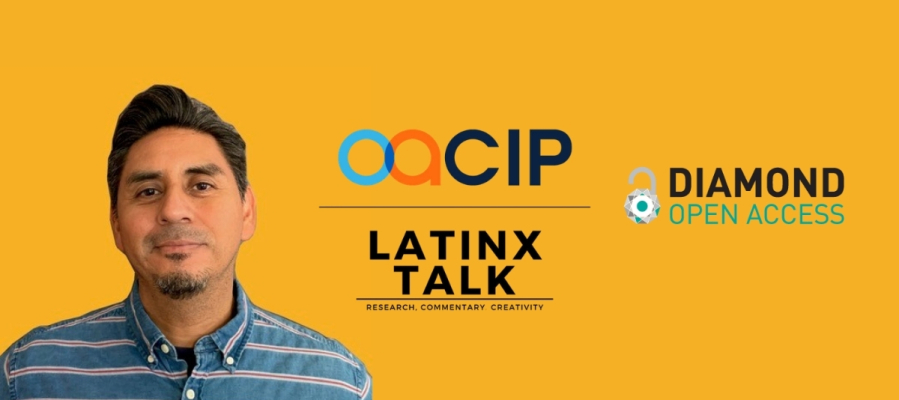
Community-Driven Diamond Open Access Publishing in Practice.
Latinx Talk was selected as one of the journals in this year’s Lyrasis Open Access Community Investment Program (OACIP) cohort! According to Lyraris, Latinx Talk is “a remarkable example of how diamond open access journals can cultivate alternatives to dominant publishing paradigms.” Diamond open access journals are often defined in terms of the absence of reader and author fees, but these journals are so much more than that. Behind each journal that participates in the Lyrasis OACIP there is a robust community of scholars committed to producing and mobilizing knowledge independent of for-profit frameworks. This independence empowers the editorial teams of these journals to engage with their disciplines on their own terms, reimagining how scholarship is created and shared in the process.
As Latinx Talk Editorial Board members wrote in our OACIP Criteria Form, we are committed to building “a scholarly chain of support, from undergraduate to graduate to postdoctoral and tenure-track [. . .] rejecting academia’s culture of competition and replacing it with an academically rigorous, yet supportive community of knowledge producers.”
In what follows, Latinx Talk Editorial Board member Dr. Rafael “Rafa” Ramírez Solórzano reflects on the work of fostering this community.
What Does It Mean to Build an Online Journal for Scholars, Not Just by Scholars?

Latinx Talk takes on bold ideas by redefining excellence through publishing undergraduate research and the work of early-career scholars. For over fifteen years, Latinx Talk has served as an interdisciplinary online platform for a diverse community of scholars, activists, and artistic creators. As a Chicanx and Latinx Studies publication venue, the journal offers a scholarly space where intellectual risks are not only welcomed but cultivated. Guided by a feminist women-of-color editorial ethos, the journal has been committed to not only creating access and equity in publishing but also a strategic site of intervention, challenging the very idea that valid knowledge or research only comes from elite institutions or from senior faculty.
In 2024, I was invited to join the Editorial Board as a junior scholar who writes and teaches about Latinx migrant social movements in the U.S. South. Yet my participation is part of a longer lineage. Behind every publication, editorial members have invested their time to shape where Chicanx and Latinx Studies is headed. The journal has brought forth emergent questions on new identities, as well as regional and ideological differences among the Latinx community. For instance, grounded in its tradition of collective knowledge production, Latinx Talk has generated innovative calls for papers on themes such as “Latinos and the Right,” “Latinx Communities and the Movement for Black Lives,” and “Deportation and Coerced Return in the Américas,” to name a few. These interventions demonstrate how editorial vision can actively shape the contours of a field.
As a social movement historian, tracing historical pasts is part of my job, but to be part of an online journal that allows junior scholars and even undergraduates to actively shape the discourse and future of a field is dynamic and forward-thinking. Latinx Talk’s labor to democratize knowledge production has led us to broaden the idea of who gets to speak, be published, and be cited. In fact, publishing across an intergenerational field of writers and artists doesn’t lower standards, but redefines what excellence is in our fields and publishing.
This brings me back to an earlier observation, Latinx Talk’s editorial process – a feminist woman of color practice. First published under the name Mujeres Talk, for over 15 years, the journal has prioritized exploring questions of difference and intersectionality within the field of Chicanx and Latinx Studies. Under this tradition, it continues to be a platform where Latinx scholars, activists, and creatives speak for themselves. As we celebrate our quinceañera, the journal continues to be committed to our sense of creative agency and social media presence, as a strategy for circulating new interpretations and writings on Latinx identities, knowledges, interests, and needs online.
About the Author
Rafael “Rafa” Ramírez Solórzano is an Assistant Professor at the Center for Latin American Studies at the University of Florida. Trained in Chicana/o and Central American Studies at UCLA, he is a social movement historian whose scholarly and pedagogical interests include Latina/o/x freedom movements, regional and relational approaches to the history of race, and women-of-color and queer-of-color feminist theories.
How to Support Latinx Talk
Contributions are made institutionally through The Lyrasis Open Access Community Investment Program (OACIP). Any organization in the world – be it a library, academic department, research center, museum, or funding agency – is invited to support OACIP. Rather than being a traditional subscription, participation in OACIP affirms a shared commitment to open access publishing and strengthens the global visibility of the labor required to produce high-quality journals. The program typically involves academic libraries, academic departments, or other organizations committing $500-$1500 per year for three years, though contributions can be adjusted higher or lower. Sponsors may choose to pay the three-year commitment upfront or on an annual basis. Consult the Latinx Talk OACIP campaign page for more information about how to contribute. Developing sustainable funding models for journals like Latinx Talk has the potential to shift conversations about how we all produce scholarship.
About OACIP
Lyrasis launched OACIP in 2020 to provide a community-driven framework and the necessary administrative infrastructure to enable libraries and other organizations to invest directly in high quality Diamond Open Access journals. The 2025-2026 cycle is currently underway, and it will run through July 31, 2026. Lyrasis is seeking three-year funding commitments to Latinx Talk and the eight other journals in this year’s cohort. Learn more about OACIP at lyrasis.org/oacip.
About Lyrasis
Lyrasis is a community-supported membership organization whose mission is to support enduring access to the world’s shared academic, scientific and cultural heritage through leadership in open technologies, content services, digital solutions and collaboration with archives, libraries, museums and knowledge communities worldwide.
Originally published by Lyrasis on April 30, 2026.