
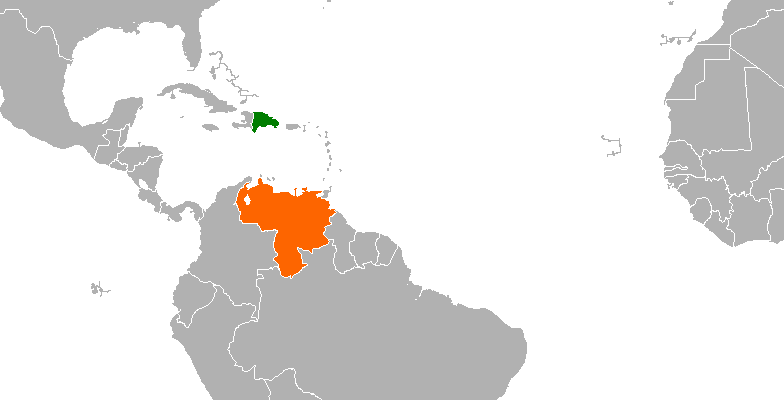
As people familiar with U.S. policy in Latin America have noted, the January 3rd U.S. military strike on Venezuela and the subsequent kidnapping of Venezuelan President Nicolás Maduro and his wife, Cilia Flores, echo U.S. policies of the last century. Framed as part of the “War on Drugs” and an effort to restore democracy, the U.S. military launched boat strikes along the Venezuelan coast that killed more than a hundred people. As in earlier eras, the United States has not acted alone, but in coordination with local political elites, including officials in the Dominican Republic and in Trinidad and Tobago.[1]
On November 26, 2025, Dominican President Luis Abinader authorized U.S. military access to the country’s main international airport and to San Isidro Air Base in support of U.S. President Donald Trump’s military operations in the Caribbean.[2] Actions like this not only demonstrate Dominican complicity with the Trump administration but also threaten the sovereignty of the country and of other nations in the Caribbean. In his response on the social network X (formerly Twitter) to the January attack, President Abinader reiterated the claim that this measure was tied to the defense of democracy.[3] While Dominican officials insist that U.S. access is limited to logistical operations such as transporting equipment or personnel, many domestic and U.S.-based Dominican social and political groups argue that this decision directly violates the Dominican constitution.[4] Moreover, many allege that the Trump administration’s objective is not the protection of democracy but a strategic effort to consolidate control over the region and its natural resources.
In a joint news conference, Defense Secretary Pete Hegseth called the collaboration with the Dominican government a “model for the region, a model we hope to build upon,” and reports estimate that about 15,000 troops have been deployed to the region.[5] This model of intervention in Latin American politics that Hegseth refers to, like the fight over control of the Panama Canal, represents a renewed strategy that has been in effect for over a century to control the resources of the Caribbean and Latin America.[6] During the era of the Monroe Doctrine and the Roosevelt Corollary, U.S. officials claimed that the Caribbean should fall under U.S. influence and framed their severe interventionist practices as efforts to promote democracy and ensure political and economic stability in the region. During the mid-twentieth century, the United States shifted from direct territorial expansion in Latin America to asserting political and economic control through shorter-term occupations. After taking over Puerto Rico and Cuba in 1898, the U.S. went on to occupy the Panama Canal Zone, Mexico, Nicaragua, the Dominican Republic, and Haiti over the next three decades. Throughout these interventions, U.S. officials claimed they aimed to establish peace and democracy, even as they pursued geopolitical interests and installed military governments led by allied officers.
Even after the early twentieth century, U.S. officials continued to intervene throughout the final decades of the century in Guatemala, Cuba, Grenada, Panama, and once again, in the Dominican Republic in 1965. Between the 1950s and 1960s, Dominican migration to the United States increased tenfold as a result of the second U.S. occupation. While Dominicans secured these increases through significant pressure on U.S. consular offices for visas, they did so in direct response to escalating U.S. interference.[7] Researchers have widely documented that U.S. political and economic policies, both within the Dominican Republic and across the broader region, have helped drive migration from Latin America to the United States.[8] Steady immigration to urban centers throughout the last decades of the twentieth century has made Dominicans one of the largest Latinx immigrant groups in New York, New Jersey, Florida, and Rhode Island.[9] Once here, many Latin American immigrants face discrimination, especially amid the anti-immigrant rhetoric and policies of the current administration.
As we stand at the outset of what may become a long-term U.S. intervention in Venezuela, it is crucial to consider the broader impact of U.S. foreign policy in Latin America. Decisions made in the region will almost certainly affect Latino communities in the United States, likely increasing migration to cities such as Chicago and New York. This movement could amplify existing pressures from the housing crisis and inflation, even as these cities confront a growing presence of federal agents. In light of these intertwined domestic and international pressures, Latinos in the U.S. must remain informed and engaged, as they are among those who will feel the consequences of these policies most directly. Some of this political energy is already visible: U.S.-based Dominican organizations, such as In Cultured Company (@inculturedco), have publicly denounced U.S. efforts on social media, though it remains unclear whether this stance is widely shared across the diaspora. Beyond such public denunciations, Dominican migrants also possess formal channels of influence, as they are eligible to vote from abroad in the 2028 Dominican elections, an opportunity to shape Dominican politics directly and challenge Dominican complicity. Taken together, these overlapping avenues of influence raise a larger question: ultimately, the choices made by Dominican communities in the United States will shed light on how diasporas navigate and contest imperial entanglements, especially when their voices may be among the most directly affected.
Endnotes
[1] Sammy Westfall and Amanda Coletta, “Here Are the Caribbean Allies Helping the U.S. against Venezuela,” The Washington Post, November 29, 2025, https://www.washingtonpost.com/world/2025/11/29/us-venezuela-dominican-trinidad-grenada/.
[2] Maria Abi-Habib et al., “Dominican Republic Allows U.S. to Use Territory to Fight International Organized Crime,” U.S., The New York Times, November 26, 2025, https://www.nytimes.com/2025/11/26/us/politics/dominican-republic-us-military.html.
[3] “Luis Abinader Speaks about the Dominican Republic’s Position after US Attacks in Venezuela,” Dominican Today, January 4, 2026, https://dominicantoday.com/dr/local/2026/01/04/luis-abinader-speaks-about-the-dominican-republics-position-after-us-attacks-in-venezuela/.
[4] “Condenamos El Servilismo y La Complicidad Del Gobierno Del PRM Con Los Crímenes de Trump Contra Venezuela,” Movimiento Socialista de Trabajadoras y Trabajadores de La República Dominicana, January 7, 2026, https://mst-rd.org/2026/01/07/condenamos-el-servilismo-y-la-complicidad-del-gobierno-del-prm-con-los-crimenes-de-trump-contra-venezuela/; In Cultured Company (@inculturedco), “In Cultured Company denounces Abinader’s decision to allow the US military access to Dominican territory to continue their illegal drug war on Venezuela and the Caribbean. What other interests do you think the Dominican government has in supporting the US?” Instagram, December 2, 2025, https://www.instagram.com/p/DRxrW3Bj9ma/?utm_source=ig_web_copy_link&igsh=MzRlODBiNWFlZA==
[5] Westfall and Coletta, “Here Are the Caribbean Allies Helping the U.S. against Venezuela”; The New York Times, “The U.S. Has Been Building Up Forces Off Venezuela for Months,” World, The New York Times, January 3, 2026, https://www.nytimes.com/2026/01/03/world/americas/us-military-buildup-caribbean-venezuela.html.
[6] Joshua Barajas, “WATCH: ‘We’re Taking’ Back the Panama Canal, Trump Says,” PBS News, March 4, 2025, https://www.pbs.org/newshour/politics/watch-were-taking-back-the-panama-canal-trump-says.
[7] Jesse Hoffnung-Garskof, “‘Yankee, Go Home . . . and Take Me with You!’ Imperialism and International Migration in Santo Domingo, Dominican Republic, 1961-1966,” Canadian Journal of Latin American and Caribbean Studies / Revue Canadienne Des Études Latino-Américaines et Caraïbes 29, no. 57/58 (2004): 44.
[8] Lisa Garcia Bedolla, “Latino migration and US foreign policy,” Berkeley review of Latin American studies 50 (2009): 50-55; Marta Tienda and Susana M. Sánchez, “Latin American Immigration to the United States,” Daedalus 142, no. 3 (2013): 48–64, https://doi.org/10.1162/DAED_a_00218.
[9] US Census Bureau, “Colombian and Honduran Populations Surpassed a Million for First Time; Venezuelan Population Grew the Fastest of All Hispanic Groups Since 2010,” Census.Gov, https://www.census.gov/library/stories/2023/09/2020-census-dhc-a-hispanic-population.html.
Featured Image: “Dominican Republic Venezuela Locator,” created by Alcastaro, Wikimedia Commons, CC BY-SA 4.0 International
Alexa Rodríguez is an Assistant Professor at the University of Virginia and a 2024 postdoctoral fellow for the National Academy of Education and Spencer Foundation. Her research examines schools, migration, and the formation of racial and national identities in both Latin America and in the United States. She is currently working on a book manuscript, Crafting Dominicanidad (forthcoming with University of North Carolina Press), an intellectual history that examines how Dominicans used public schools to articulate and circulate competing notions of racial, class, and national identity during the early twentieth century. Her work has been published in scholarly journals such as History of Education Quarterly and Latino Studies, as well as public-facing venues such as City & State New York, Clio and the Contemporary, and the blog of the History of Education Society in the UK. Rodríguez’s term on the Editorial Board is from 2024 to 2027.