

Introduction
Among cultures that have suffered oppression at the hands of colonial powers, artistic expression has long been a powerful tool of resistance by challenging the status quo and illuminating the repercussions of colonialism. The United States’ enduring colonial relationship with Puerto Rico has led the island to a failing infrastructure and economic collapse, and these conditions have left it especially vulnerable to catastrophes like natural disasters. Notably, Hurricane María wreaked havoc on the land in September 2017, exposing the implications of this weakened state; necessities like water and power in particular became increasingly unpredictable, with power outages becoming part of everyday life and water quality commonly violating the Safe Water Drinking Act.[1] However, following natural disasters, Puerto Rican visual artists resist colonialism by emphasizing themes of destruction and grief, shifting from rejecting U.S. cultural hegemony and turning toward illuminating the effects of colonialism on Puerto Ricans on the island and beyond.
Puerto Rico was first colonized by the Spanish in 1493, and Spain remained colonial rulers until 1898, when the United States acquired the island as a result of the Spanish-American War. Puerto Ricans had no say in this decision. Puerto Ricans later became U.S. citizens, but they lack many of the rights afforded to citizens of the mainland, like voting for the U.S. president. In the mid-twentieth century, incentivizing tax programs like Section 936 of the Internal Revenue Code made Puerto Rico a tax haven for corporations, but when it ended in 2006, over 40% of the companies that benefited from this exemption left the island, and there was no economic plan set in place.[2] This lack of economic planning led to a fiscal disaster and catalyzed the economic recession that crippled public goods and services and left Puerto Rico increasingly vulnerable to the destruction caused by Hurricane María.[3] The conditions resulting from this colonial relationship have also prompted much of the migration from Puerto Rico to the U.S., consequently generating an ambiguous political status for Puerto Ricans on the island and a second-class citizenship for those living on the mainland.[4]
Visual Art and the Colonial Relationship in Puerto Rico
Visual art has been a powerful vehicle for education and raising awareness about the colonial relationship between the United States and Puerto Rico, and therefore for disrupting hegemonic American attitudes and beliefs surrounding colonialism. Through the use of various media and themes, Puerto Rican creatives have amplified important, but often hidden, stories. Photography, in particular, has been a popular mode for visual artists to capture and share the specific effects of colonialism on Puerto Rican culture and everyday life. In Latinx Photography in the United States: A Visual History, Elizabeth Ferrer writes, “Concepts of hybrid identity, the ability to negotiate freely between local and global culture and between tradition and contemporaneity, and a political landscape marked by divisions between advocates for statehood and independence have prompted generations of artists and photographers to produce layered, complex cultural statements.”[5] In Latinx Art: Artists, Markets, and Politics, scholar Arlene Dávila remarks that Puerto Rican artists often occupy a “neither here nor there” position within art institutions that favor national over racialized and diasporic identities[6]. This dynamic reflects how Puerto Rico is often politically and culturally tied to the United States, yet also treated as an outsider. This neglect mirrors Puerto Ricans’ divided opinions on their colonial status, emphasizing how uncovering the effects of colonialism through art challenges this marginalization and the indifference many feel toward the island’s condition.
Héctor Méndez Caratini exemplifies artistic resistance in Puerto Rican art before María, using photography to document and critique social and cultural conditions. Inspired by photographer Jack Delano’s social documentation of Puerto Rico, Caratini chronicled the everyday life of Puerto Ricans in small towns and rural areas. Caratini studied photography in New York in the early 1970s before returning to Puerto Rico, where, aware of his lack of knowledge of the island’s history, he began working with renowned scholar and cultural anthropologist Ricardo Alegría. Scholars emphasize how artists have long worked within broader networks connecting Puerto Rico to Latin American art worlds, allowing them to critique colonial and social conditions while placing themselves in these dialogues.[7] Many of Caratini’s works examine key cultural subjects like indigenous Puerto Rican (Taíno) rock engravings, followers of the bull-riding tradition called vaqueros, colonial coffee-growing plantations, the tradition called mascaradas (making masks for wearing at religious festivals), abandoned sugarcane plantations, and Afro-Caribbean spiritual practices in Loíza Aldea and the African presence in Puerto Rico.[8] His photography can be understood within this tradition of politically engaged art, highlighting local realities as well as Puerto Rico’s links to broader artistic practices.
Caratini later created a mixed-media series in which he tells the story of the small island of Vieques, located off Puerto Rico’s main coast, which had been used for weapons testing by the U.S. Navy. He “…tells a story about everyday life on the small island, the military’s damaging impact on the environment and on the health of the local population, small local protests, and larger, well-organized acts of civil disobedience.”[9] He did this in the style of a Via Crucis (Stations of the Cross), drawing connections between protestors and Christian figures and themes.[10] By using religious iconography, Caratini positions resistance as a sacred act that is rooted not only in politics, but in faith and shared trauma.
In Caratini’s black and white series, titled Centrales Azucareras de Puerto Rico 1974-1992, Caratini explores sugarcane as a symbol for Puerto Rico’s colonial economy.[11] The sugar industry was once the most important economic activity for North American capitalists, in which they monopolized land while workers faced gruesome conditions. Agriculture in Puerto Rico had been more diverse before this, but when sugarcane production became more profitable in other countries, Puerto Rico’s sugar profits were reinvested into other industries, and agriculture diminished.[12] Caratini’s drab photographs of sugarcane mills in Puerto Rico contrast machinery, sugarcane plants, and workers in exploration of shifting technological and economic conditions.
In Image 1 of the above series (featured photo), Caratini captures a patch of trees in the middle of a grassy field. A smokestack peeks through the treetops, as if the structure has been incorporated into the ecosystem. The air around the trees and the smokestack is foggy, thick. This blending of industry and nature captures the uneasy coexistence between Puerto Rico’s natural beauty and its long history of exploitation. The smokestack, a metaphor for the industry that once dominated the economy, represents colonial extraction; its presence is concealed by, but also intruding upon, the natural landscape. Caratini’s composition converts this ordinary scene into a commentary on survival, persistence, and the scars from industrial colonialism. A similar tension is seen in image 4, where Caratini depicts a worker and his ox navigating through a field of broken, cultivated sugarcane while a sea of uncut sugarcane sways in the wind at his back. The image honors the physical and cultural labor that sustains the island, highlighting the contrast between those who profit from the land and those who perform the labor required to maintain it. This piece conveys the weight of manual labor and the broader struggle for autonomy within Puerto Rico’s colonial context.
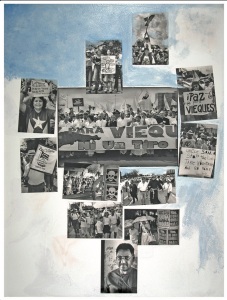
Caratini further highlights the complex relationship between colonization and life in Puerto Rico with religion in Vieques: Crónicas del Calvario (Vieques: Chronicles of the Calvary). In one of these pieces (see Figure 2), Caratini compiles various images, mainly of Puerto Rican protestors in Vieques, on a background that starts light blue at the top and fades to white in the lower half. The largest image in the center pictures a crowd holding up a large banner, and this focal image is framed by various smaller images of protestors. On the left side, one of these protestors carries a sign reading “Uncle Sam, stop the bomb, take your tanks and go home,” and another sign in the image above it reads, “Paz para Vieques!” or “Peace for Vieques.” Another image of a protest captures a pole with the warning symbol for toxic chemicals plastered over it. The lowermost picture portrays a smiling priest who stands out among the other charged images.[13] In piecing these images into one artwork, Caratini reflects the importance of religion, activism, and community in Puerto Rico, as well as the significance of Puerto Ricans uniting against colonial forces. He reminds the viewer that while it is not often visible to outsiders, Puerto Rico’s land and people are exploited and abused for the benefit of the United States. Despite this, Puerto Ricans remain strong and unified. Where there is anger and resentment towards the military occupation of Vieques, there are also community leaders and solidarity. Where there is toxic waste and environmental destruction, there are people willing to fight and rebuild. This project ultimately contributed to the success of the grassroots campaign that helped end the presence of the U.S. Navy on Vieques,[14] reflecting how even when art uncovers stories of conflict and destruction, it can be a tool for inspiring hope and highlighting how people cope and work together to resist colonialism.
Hurricane María, Colonialism, and the Arts
Hurricane María had particularly disastrous effects on Puerto Rico and revealed how colonialism has left the island weakened and vulnerable, causing a shift in the themes explored in art. To celebrate death in Puerto Rico, an aspect of physicality is often crucial; to memorialise the deceased, Puerto Ricans frequently partake in conventional practices like wakes and novenas, sometimes creating commemorative objects like T-shirts or stickers. However, the catastrophic effect of Hurricane María catalyzed a lack of proper mortuary care and stripped many of the ability to properly celebrate and honor the dead.
After the storm, Puerto Ricans were forced to take charge of emergency recovery efforts as the state failed to provide adequate aid. As anthropologist Yarimar Bonilla summarizes, “In the initial aftermath of the storm, many Puerto Ricans came together to set up community kitchens, organize solidarity brigades, clean up debris, place tarps on roofless homes, distribute solar lights, and take charge, if not of the recovery, at least of the emergency in the face of an absent state.”[15] A month before the storm, FEMA had admitted to having lost a truck full of water, and a year later, a drone photographer discovered an abandoned military airport containing 20,000 pallets of unopened water bottles.[16]The lack of proper resources led to many subsequent deaths; a study by the Universidad Carlos Albizu and Harvard University estimated 4,645 deaths but mentioned that “Our estimate of 4,645 excess deaths . . . is likely to be conservative since subsequent adjustments for survivor bias and household-size increase this estimate to more than 5,000.”[17] The number 4,645 thus became a key symbol in the following protests and resistance efforts to shed light on the government’s neglect. Overall, much of the art responding to María focuses on exploring these themes of death and grief, not only to memorialize the deceased, but also as a means of criticizing the lack of care the hurricane’s victims received. As Yarimar Bonilla notes, drawing on the works of Rivera Santana and Marienne Ramírez, “…visual art has become an important site of catharsis as Puerto Ricans confront the effects of both natural and man-made disaster…visual artists have been engaging with the longue durée of colonialism in Puerto Rico and using their art to assert a decolonial aesthetic and cultural sovereignty.[18]” This framing connects the pre- and post-María artists who expose ongoing colonial neglect while also reclaiming culture. While Caratini’s work before María reflects ongoing colonial tensions and cultural resilience, artists after the storm shifted focus toward revealing the harsh realities and lived experiences of Puerto Ricans in new ways.
Garvin Sierra Vega, commonly known as Taller Gráfico, approached the lack of cadaver care as well as the myriad other issues Puerto Ricans faced after María in his work. In early 2023, Taller Gráfico’s work was displayed in the exhibit titled No Existe un Mundo Poshuracán (A Post-Hurricane World Does Not Exist): Puerto Rican Art in the Wake of Hurricane María at the Whitney Museum of American Art in New York City. His works are often simple, morbid, and humorous in nature; “With physical posters used during protests and digital iterations via Instagram and Twitter, Sierra’s stark images are in the style of Puerto Rican serigrafías, serigraphs, which use bold visual elements such as silhouettes to send powerful messages.”[19] In many of these serigraphs, Taller Gráfico features the number 4,645. In his piece titled 4654+, Taller Gráfico isolates the number “4654+” against a deep blue background, accented by a lighter blue curved bar that resembles a partially filled progress meter. The allusion to a progress bar, as well as the plus sign at the end of 4654, suggests that the true scope of this loss cannot be measured and transforms the statistic into a symbol for Puerto Rico’s lapse in progress. Announcing and shedding light on the real estimated death toll of María not only spreads awareness on the number of people affected by the storm itself, but also provides context on the government corruption and failing infrastructure that led to these conditions.
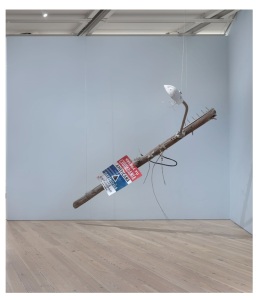
Another powerful work in this exhibition responding to Hurricane María is Untitled (Valora tu mentira americana), or “value your American lie,” by Gabriella Torres. The piece features a broken streetlight, alluding to the havoc caused by the storm. The title of the piece as well as a sign on the post reading “valora tu ciudadania Americana” (“value your American citizenship”) elicits the viewer “…to question the apparent safety net of Puerto Rican political status, its US citizenship and therefore (presumed) preferential relationship with its Federal Government, in the face of bare destruction, while also inviting the viewer to question the lie or if accepted as such, ask the question: ‘how did we arrive at this ‘lie?’”[20] Torres creates an environment representative of María’s effects on hard infrastructure (roads, buildings, etc.) as well as the failure of the island’s soft infrastructure (government, education, healthcare, etc). Through this work, Torres examines what it means to be a survivor of María, and in representing this experience, resists the corruption and colonial forces that impaired the island.
Artists have also used photography as a means of exploring the conditions of life for Puerto Ricans in the wake of Hurricane María. Photographer Erika P. Rodríguez was born in Puerto Rico in 1988 and has lived on the West Coast as well as in San Juan. She examines Puerto Ricans in times of crisis and how these periods affect people’s identities,[21] like in her series Enjambre (Swarm), where Rodríguez focuses specifically on the theme of destruction. She captures various instances of destruction ranging from nature to houses and buildings.[22] In one of these photographs (Untitled), a building hallway contains a shattered statue. The walls are painted blue and held up by white columns, while a red fire extinguisher peeks out from one side. The base of the statue sits unharmed along the right wall, but the rest lies in fragments on the floor, and a religious artwork above alludes to the statue’s original form. The hallway is cold and barren, and the destruction feels deeply intimate. By isolating the fragments within the structured hallway, Rodríguez transforms a scene of physical destruction into a contemplation of cultural and spiritual vulnerability. The stark colors, emptiness, and contrast between shattered ceramic and its intact base guide the viewer’s eyes while reinforcing a sense of absence and loss. Rodríguez conveys that the storm’s effects went beyond material destruction, exposing the vulnerability of cultural identities, faith, and the fabric of everyday life in Puerto Rico.
Final Thoughts
Through examining the trauma and grief from Hurricane María, artists explore the island’s colonial relationship with the United States outside the context of resisting United States cultural values. Puerto Rican artists have an extensive history of spreading awareness about the state of the island through their work, and this tradition is especially apparent in art responding to Hurricane María. By documenting Puerto Rican everyday life and culture, particularly through photography, artists have rejected the erasure of Puerto Rican history and traditions from cultural assimilation. These have been effective tools of resistance in revealing the harsh realities many Puerto Ricans face. Puerto Rico is often regarded as a state, and as benefitting from being a colony of the United States, but visual art has allowed Puerto Ricans to shed light on the damaging effects of this relationship that are often ignored. Scholars such as Ferrer[23] and Dávila[24] note that Puerto Rican artists have long used their work to explore and comment on complex colonial, national, and diasporic identities. However, by examining grief and destruction, creatives have revealed new perspectives on colonialism and the current conditions of Puerto Rico. These perspectives compel viewers to assess what they know about Puerto Rico and to resist upholding its longstanding colonial structures.
Featured Photo Credit: Image #1 in “Centrales Azucareras de Puerto Rico 1974-1992” series by Héctor Méndez Caratini.
Bibliography
Bonilla, Yarimar. “The Coloniality of Disaster: Race, Empire, and the Temporal Logics of Emergency in Puerto Rico, USA.” Political Geography 78 (April 2020): 102181. https://doi.org/10.1016/j.polgeo.2020.102181.
Bonilla, Yarimar, and Marisol LeBrón. Aftershocks of Disaster: Puerto Rico Before and after the Storm. Haymarket Books, 2019. http://ebookcentral.proquest.com/lib/well/detail.action?docID=5754779.
Dávila, Arlene. Latinx Art: Artists, Markets, and Politics. Duke University Press, 2020. https://doi.org/10.2307/j.ctv14t48z5.
Ferrer, Elizabeth. Latinx Photography in the United States: A Visual History. University of Washington Press, 2021. https://www.jstor.org/stable/j.ctv1f884k4.
Meléndez-Badillo, Jorell. “Broken Promises and Ongoing Resistance.” In Puerto Rico, 164–77. A National History. Princeton University Press, 2024. https://doi.org/10.2307/jj.7492229.15.
———. “The Night Everything Went Silent.” In Puerto Rico: A National History. Princeton University Press, 2024. https://www-jstor-org.ezproxy.wellesley.edu/stable/jj.7492229.16?seq=1.
———. “The Storm After Maria.” In Puerto Rico: A National History. Princeton University Press, 2024. https://www-jstor-org.ezproxy.wellesley.edu/stable/jj.7492229.17?seq=1.
Méndez Caratini, Héctor. “Héctor Méndez Caratini.” Accessed May 9, 2025. https://hectormendezcaratini.com/.
Ramírez Rodríguez, Stella M. “Art as Protest and Memorialisation: A Survey of Local and Diasporic Responses to Hurricane María.” Mortality 29, no. 2 (May 2024): 289–305. https://doi.org/10.1080/13576275.2023.2231891.
Rivera-Santana, Carlos. “Aesthetics of Disaster as Decolonial Aesthetics: Making Sense of the Effects of Hurricane Maria through Puerto Rican Contemporary Art.” Cultural Studies 34, no. 3 (May 3, 2020): 341–62. https://doi.org/10.1080/09502386.2019.1607519.
Rodríguez, Erika P. “Erika P. Rodríguez.” Erika P. Rodríguez. Accessed June 12, 2025. https://www.erikaprodriguez.com.
Whalen, Carmen Teresa. “Colonialism, Citizenship, and the Making of the Puerto Rican Diaspora: An Introduction.” In Puerto Rican Diaspora, edited by Carmen Teresa Whalen and Víctor Vázquez-Hernández, 1–42. Historical Perspectives. Temple University Press, 2005. https://www.jstor.org/stable/j.ctt14bt09b.4.
Endnotes
[1] Jorell Meléndez-Badillo, “The Night Everything Went Silent,” in Puerto Rico: A National History (Princeton University Press, 2024), 181–83, https://www-jstor-org.ezproxy.wellesley.edu/stable/jj.7492229.16?seq=1.
[2] Jorell Meléndez-Badillo, “Broken Promises and Ongoing Resistance,” in Puerto Rico, A National History (Princeton University Press, 2024), 164, https://doi.org/10.2307/jj.7492229.15.
[3] Meléndez-Badillo, 164.
[4] Carmen Teresa Whalen, “Colonialism, Citizenship, and the Making of the Puerto Rican Diaspora: An Introduction,” in Puerto Rican Diaspora, ed. Carmen Teresa Whalen and Víctor Vázquez-Hernández, Historical Perspectives (Temple University Press, 2005), 41, https://www.jstor.org/stable/j.ctt14bt09b.4.
[5] Elizabeth Ferrer, Latinx Photography in the United States: A Visual History (University of Washington Press, 2021), 176, https://www.jstor.org/stable/j.ctv1f884k4.
[6] Arlene Dávila, Latinx Art: Artists, Markets, and Politics (Duke University Press, 2020), 25, https://doi.org/10.2307/j.ctv14t48z5.
[8] Ferrer, 184.
[9] Ferrer, 185–86.
[10] Ferrer, 185.
[11] Sugar Mills in Puerto Rico 1974-1992 – Héctor Méndez Caratini, n.d., accessed October 19, 2025, https://hectormendezcaratini.com/centrales-azucareras-de-puerto-rico-1974-1992/.
[12] Economic Research Group of the Secretariat of Information and Propaganda et al., “The Economic Importance of Puerto Rico for the United States,” Latin American Perspectives 3, no. 3 (1976): 46–47.
[13] Méndez Caratini, “Héctor Méndez Caratini.”
[14] Ferrer, Latinx Photography in the United States, 186.
[15] Yarimar Bonilla, “The Coloniality of Disaster: Race, Empire, and the Temporal Logics of Emergency in Puerto Rico, USA,” Political Geography 78 (April 2020): 8, https://doi.org/10.1016/j.polgeo.2020.102181.
[16] Jorell Meléndez-Badillo, “The Storm After Maria,” in Puerto Rico: A National History (Princeton University Press, 2024), 190, https://www-jstor-org.ezproxy.wellesley.edu/stable/jj.7492229.17?seq=1.
[17] Meléndez-Badillo, “The Night Everything Went Silent,” 185.
[18] Yarimar Bonilla and Marisol LeBrón, Aftershocks of Disaster: Puerto Rico Before and after the Storm (Haymarket Books, 2019), 23, http://ebookcentral.proquest.com/lib/well/detail.action?docID=5754779.
[19] Stella M. Ramírez Rodríguez, “Art as Protest and Memorialisation: A Survey of Local and Diasporic Responses to Hurricane María,”Mortality 29, no. 2 (May 2024): 298, https://doi.org/10.1080/13576275.2023.2231891.
[20] Carlos Rivera-Santana, “Aesthetics of Disaster as Decolonial Aesthetics: Making Sense of the Effects of Hurricane Maria through Puerto Rican Contemporary Art,” CULTURAL STUDIES 34, no. 3 (May 3, 2020): 341–62, https://doi.org/10.1080/09502386.2019.1607519.
[21] Ferrer, Latinx Photography in the United States, 192–93.
[22] Erika P. Rodríguez, “Erika P. Rodríguez,” Erika P. Rodríguez, accessed June 12, 2025, https://www.erikaprodriguez.com.
[23] Elizabeth Ferrer, Latinx Photography in the United States: A Visual History (University of Washington Press, 2021), https://www.jstor.org/stable/j.ctv1f884k4.
Lucía López’s article on the connection between natural disasters and art is a fascinating examination of the reach of colonialism in Puerto Rico. As a Puerto Rican woman born and raised in NYC with close ties to the island, I commend her investigative and creative spirit in exploring these links. In full disclosure, I am Lucía’s grandmother and so very proud of her as a fourth-generation boricua. ¡Pa’lante, Lula!